

What if accepting help could protect an older adult’s independence rather than take it away? If you’re noticing changes in a loved one’s routines, it’s natural to wonder whether senior daily living assistance might help. You may also have questions about safety, privacy, and bringing someone into the home.
Those concerns deserve care and respect. Support doesn’t have to mean taking over. It can focus on what your family member wants to keep doing and where help would make the day easier. A thoughtful conversation about specific observations can help you explore options together without making decisions for your loved one.
This guide explains common forms of daily support, from personal care and mobility assistance to meal preparation, errands, light housekeeping, and companionship. You’ll also learn how to notice possible needs respectfully, talk about help as a shared choice, and ask useful questions when considering in-home assistance. The goal is to find support that fits your family member’s routines, preferences, and sense of independence.
Key Takeaways
- Senior daily living assistance can be tailored to everyday tasks while preserving an older adult’s choices and independence.
- Notice changes in specific routines to identify where support may help, without assuming every task needs attention.
- Understand how practical daily support, companionship, and skilled nursing differ so you can explore the right kind of care.
- Use a calm, collaborative conversation to learn what help your loved one wants and agree on a starting point together.
- When comparing in-home options, ask about tasks, staff roles, scheduling, communication, and whether the provider serves your area.
What Is Senior Daily Living Assistance, and What Can It Support?
It can be hard to balance safety concerns with your loved one’s wish to keep familiar routines and make their own choices. Accepting help doesn’t have to mean giving up independence. Support can fill a specific gap while leaving your family member in charge of the parts of the day they still want to manage.
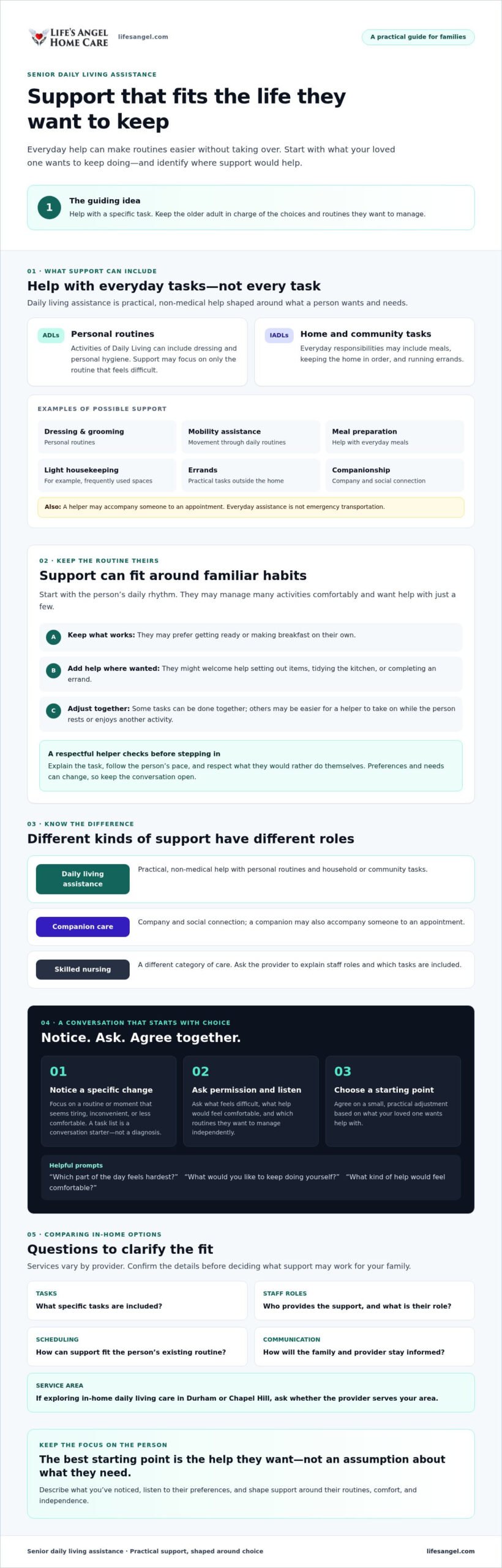
Senior daily living assistance is practical, non-medical help with everyday personal routines and household or community tasks, shaped around what an older adult wants and needs help with.
Some personal routines are known as Activities of Daily Living (ADLs), such as dressing and personal hygiene. Other everyday responsibilities, sometimes called instrumental activities of daily living, include preparing meals, keeping the home in order, and running errands. A person may need help with one task and manage others comfortably on their own.
Which everyday activities may call for support?
Needs differ from one person to another, and help can be limited to particular tasks. It may include dressing or grooming, preparing meals, light housekeeping, or errands. Mobility assistance can support movement through daily routines, while companionship offers company and social connection. An older adult may also want someone to accompany them to appointments.
Use these examples to describe what’s changing without assuming every task needs attention. Services vary by provider, so ask what’s included and agree on the specific help your family member wants.
How can support preserve choice and dignity?
Begin with permission, not assumptions. Ask what feels difficult, what kind of help would feel comfortable, and which routines your loved one prefers to manage independently. If they want to prepare breakfast themselves but would welcome help with errands, that distinction can guide a more respectful plan.
Familiar preferences matter, too. Ask how they like their day organized, what they’d like an assistant to do, and what they’d rather handle themselves. A helper can offer support without taking over by explaining each task, checking before stepping in, and following the person’s pace. Needs and preferences may change, so keep the conversation open and revisit the arrangement together.
If you’re exploring hands-on help with personal routines, our personal care services guide explains what that support may involve. Clear conversations about tasks, comfort, and boundaries can help your family identify assistance that respects both well-being and independence.
How Daily Living Assistance Fits Around a Senior’s Existing Routine
Support works best when it starts with the older adult’s daily rhythm, rather than a schedule imposed from outside. Your family member may manage many activities comfortably and want help with only a few. Discussing when assistance would be useful can shape support around existing habits and leave time for the things they prefer to do independently.
Personal daily activities involve caring for oneself, while household and community tasks involve managing the home or taking part in activities outside it.
Personal routines and practical household help
For example, a senior might prefer to get ready on their own but appreciate help organizing items they use each morning. They may enjoy making breakfast while welcoming assistance with setting things out or tidying the kitchen afterward. Light housekeeping can focus on frequently used spaces rather than changing how the whole home is arranged.
Some tasks can be done together. Others may be easier for a helper to take on while the senior rests or spends time on something they enjoy. Let the person’s preferences guide that balance.
Mobility, errands, and getting to appointments
Mobility assistance may support ordinary movement around the home, such as getting from one room to another. Errand assistance can help with practical tasks outside the home, and an accompanying helper may provide company and support during an appointment. These are everyday supports, not emergency transportation.
Needs can vary from day to day and may shift over time. A list of tasks can help start a conversation, but it isn’t a diagnosis or proof that someone needs help with everything on it. Ask which moments feel tiring, inconvenient, or less comfortable, then consider a small, practical adjustment.
Imagine a morning when an older adult gets ready at their own pace, with help available for a household task they find difficult. Later, assistance might involve an errand or accompaniment to an appointment, depending on what they want and what the day calls for. This is an example, not a fixed schedule. The right arrangement depends on the person’s routines and the support being explored.
If mobility is a particular concern, the senior mobility family guide can help you think through mobility-related decisions. To learn about listed in-home support such as mobility assistance, errands, and light housekeeping, you can also review Life’s Angel Home Care’s assistance options.
Daily Living Assistance, Companion Care, and Skilled Nursing: What’s Different?
These terms can sound similar when your family is trying to understand what kind of help might fit. A person may benefit from more than one type of support over time, but everyday assistance, companionship, and skilled clinical care have different purposes. Accepting help at home does not automatically mean moving into a facility. The right setting and support depend on the person’s needs and preferences.
| Type of support | Main focus | Examples |
|---|---|---|
| Daily living assistance | Practical help with personal routines and everyday tasks | Personal care, mobility assistance, meal preparation, errands, light housekeeping, or accompanied appointments |
| Companion care | Social connection and help with selected everyday activities | Conversation, companionship, meal preparation, errands, or light housekeeping |
| Skilled nursing | Clinical care provided by qualified nursing professionals | Examples may include wound care, injections, or clinical management of health conditions |
Practical daily support and companionship can overlap, such as sharing a meal while receiving help with meal preparation. Skilled nursing is different: it involves clinical tasks, not simply assistance with a familiar routine. Ask providers which tasks their services include, who performs them, and what falls outside their staff’s role.
What non-medical daily support can and cannot mean
Senior daily living assistance can mean help with tasks such as personal care, preparing a meal, running errands, or keeping frequently used areas tidy. It supports routines; it isn’t a diagnosis or medical treatment. Life’s Angel Home Care lists personal care, mobility assistance, companionship, errands, light housekeeping, meal preparation, and accompanied appointments among its services. Confirm directly with any provider that the specific help your family member wants is within its offerings.
When a family should ask about a different level of care
If you’re concerned that a need involves clinical care, or a change seems urgent, contact an appropriate health professional for guidance. Observations can help you explain what’s happening, but a list of changes can’t determine the right care on its own. For prompts on what families may notice, see signs an aging parent may need home care.
Some older adults may remain at home with practical assistance, while others may need a different setting or clinical support. These options aren’t interchangeable, and no single arrangement fits every family. A careful conversation about the tasks involved and the older adult’s wishes can help clarify what to explore next.
How to Talk With a Senior and Identify the Help They Want
Talking about support can feel delicate. Your loved one may worry about losing privacy or control, while you may be concerned about changes you’ve noticed. Start with curiosity rather than a conclusion. The aim is to understand what they experience and decide together whether help could make a particular task easier.
A low-pressure conversation can follow five steps:
- Notice. Pay attention to recurring practical difficulties and the circumstances around them. Separate what you directly observed from what you’re assuming, and avoid treating one difficult day as proof of a lasting problem.
- Ask. Choose a calm moment and bring up one specific task. You might say, “I’ve noticed errands seem tiring lately. How are they feeling for you?”
- Listen. Give your family member time to share what’s frustrating, what feels manageable, and what they’d like to keep doing independently. Their view may differ from yours, and that perspective matters.
- Agree. Ask what small change, if any, would make the day easier. Discuss what help feels acceptable rather than presenting a complete plan as a decision already made.
- Revisit. Check in after an agreed first step. Routines and preferences can change, so keep the conversation open and adjust together if needed.
Before contacting a provider, jot down the tasks your loved one wants help with, the routines they prefer to keep, and any questions you both have. For example, note that preparing a meal feels comfortable but an errand feels difficult, or that they want help with a particular household task only. Specific examples make it easier to discuss options without labeling someone as unable to manage.
Agreeing on support also means talking about comfort at home. Ask your family member what privacy matters to them, how they like tasks handled, and what kind of communication feels respectful. When speaking with a prospective provider, clarify which tasks are included, who may perform them, and how preferences can be shared with staff. This helps you assess whether the proposed senior daily living assistance reflects the older adult’s wishes.
A first step doesn’t need to settle every question. It can be as simple as exploring help with one task, then checking together whether it feels useful and comfortable. If you’re ready to discuss support with personal care, mobility, errands, or other listed services, contact Life’s Angel Home Care to ask about its in-home assistance options.
In-Home Daily Living Care in Durham and Chapel Hill
Choosing help at home is a personal decision, and it’s reasonable to ask detailed questions before inviting someone into a familiar space. A clear conversation can help you understand what a provider offers, how support may fit your family member’s routines, and whether the arrangement feels comfortable to everyone involved.
Questions to ask before arranging help
Start with the specific tasks your loved one wants support with, then ask the provider:
- Which tasks are included? Ask whether the provider offers the particular help you’re considering, such as personal care, mobility assistance, meal preparation, errands, light housekeeping, companionship, or accompanied appointments. Clarify what requests fall outside its services.
- Who may provide the assistance? Ask about staff roles and the experience or qualifications relevant to the tasks. Life’s Angel Home Care reports employing board-certified registered nurses, nursing assistants, and care aides, and describes its care staff as BLS and CPR/AED certified. Confirm current credentials and ask which staff roles may be involved. These details don’t establish who will be assigned to a particular family.
- How does scheduling work? Ask how hourly or scheduled-shift arrangements are set up and whether the options fit the hours and tasks your family has in mind. Confirm details directly rather than assuming a particular schedule is available.
- How are preferences and updates shared? Discuss how the older adult’s routines, privacy preferences, and concerns can be communicated, and who in the family should receive updates.
- Is the home within the service area? Confirm coverage for the specific address and ask whether the provider can support the agreed tasks there.
A local conversation can clarify the next step
Life’s Angel Home Care is based in Durham and, according to the supplied business information, serves Durham and Chapel Hill. Its listed in-home services may be one option for families exploring senior daily living assistance in those communities. The agency’s location alone doesn’t determine whether its offerings, staff roles, or scheduling will suit your family, so ask questions and consider the older adult’s wishes before making a decision.
For families in Durham, Chapel Hill, or Raleigh, confirm service-area coverage for the specific address before arranging help. You can prepare by writing down the tasks your family member wants assistance with, the parts of their routine they prefer to manage independently, and any concerns about communication or privacy. Then discuss those needs directly with prospective providers. A thoughtful conversation with Life’s Angel Home Care can help you explore whether its listed support may fit your family’s needs, without pressure to decide before you’re ready.
Choose Support That Honors Your Loved One’s Routine
Finding the right help starts with noticing which everyday tasks feel difficult and asking your loved one what they would like support with. Senior daily living assistance can focus on specific routines, helping an older adult stay involved in the choices that shape their day. Practical help, companionship, and skilled nursing serve different purposes, so confirm that a provider’s services match the needs you’ve discussed.
As you explore options, ask about included tasks, staff roles, scheduling, communication, and service-area coverage. Life’s Angel Home Care is based in Durham and serves Durham and Chapel Hill. The agency reports employing board-certified registered nurses, nursing assistants, and care aides, and describes its staff as BLS and CPR/AED certified. Confirm current credentials and ask which staff roles may be involved in the support your family is considering.
If you’re ready to explore whether the agency’s listed daily support may suit your family, talk with Life’s Angel Home Care about daily support. You can take the conversation one step at a time, with your loved one’s comfort, preferences, and dignity at the center.
Frequently Asked Questions
What is senior daily living assistance?
Senior daily living assistance is practical support with everyday routines, such as personal care, mobility assistance, meal preparation, light housekeeping, errands, companionship, or accompanied appointments. An older adult may accept help with selected tasks while continuing other routines independently. Services vary by provider, so ask what’s included and how the help differs from skilled clinical care. In Durham and Chapel Hill, confirm a provider’s current offerings and coverage before choosing.
What activities can daily living assistance include?
Daily living assistance may include help with personal routines, moving around the home, preparing meals, keeping commonly used areas tidy, running errands, or attending appointments with someone. A provider’s services and staff roles can vary, and not every caregiver performs every task. Write down the specific activities your family member wants help with, then ask which are offered. If you’re in Durham, Chapel Hill, or Raleigh, confirm service-area coverage directly.
How do I know if my parent needs help with daily activities?
Look for recurring difficulties with routines your parent says matter to them, rather than drawing conclusions from one unusual day. Ask what feels harder and what support, if any, would feel comfortable. Keep firsthand observations separate from assumptions, and listen to your parent’s view before suggesting a solution. If a change seems sudden, urgent, or related to health, contact an appropriate health professional for guidance.
Can daily living assistance help someone remain independent at home?
It can support independence when help focuses on tasks the older adult wants assistance with and respects their preferences. For example, a helper might assist with an errand or meal preparation while the person continues other routines on their own. No arrangement can guarantee a particular outcome. Talk together about goals, privacy, and boundaries, then check in as routines or needs change to see whether the support still feels right.
Is daily living assistance the same as skilled nursing care?
No. Daily living assistance generally means practical help with personal routines and household tasks, while skilled nursing involves clinical care provided by appropriately qualified professionals. A staff member’s nursing credential doesn’t by itself mean a provider offers skilled nursing services. Ask what tasks the provider performs and which staff roles may handle them. If a need appears medical or urgent, seek advice from a qualified health professional.
How can families talk to an older adult about accepting help?
Start with a specific observation and a caring question, rather than telling your loved one they can’t manage. You might ask, “I’ve noticed errands seem tiring. What kind of help, if any, would feel useful to you?” Listen without rushing to solve everything, then agree on one manageable next step. Revisit the conversation together later, since preferences and circumstances can change over time.