

A nurse on staff can be an important part of your decision, but start by identifying the support your loved one needs. The most useful questions to ask home care agencies in NC cover nursing roles, caregiver training and employment, and how care is tailored to the person receiving it.
It’s natural to want reassurance about the people coming into your loved one’s home. Ask how caregivers are screened and supervised, and whether your family can meet a caregiver before regular visits begin. Clear answers can help you feel prepared and included.
This guide covers practical questions about nursing support, caregiver qualifications and employment, meeting potential caregivers, and personalized services. You’ll have a clearer sense of what to discuss and how to find support that respects your loved one’s comfort, routines, and dignity.
Key Takeaways
- Ask how caregivers are screened, trained, and supervised so you understand the safety steps behind their care.
- Clarify whether caregivers are agency employees or contractors, and how insurance coverage and cancellations are handled.
- Include your loved one in meeting potential caregivers and discuss how the family will receive care updates.
- Describe your loved one’s routines and support needs when discussing a personalized care plan and suitable services.
1. Do caregivers receive ongoing training?
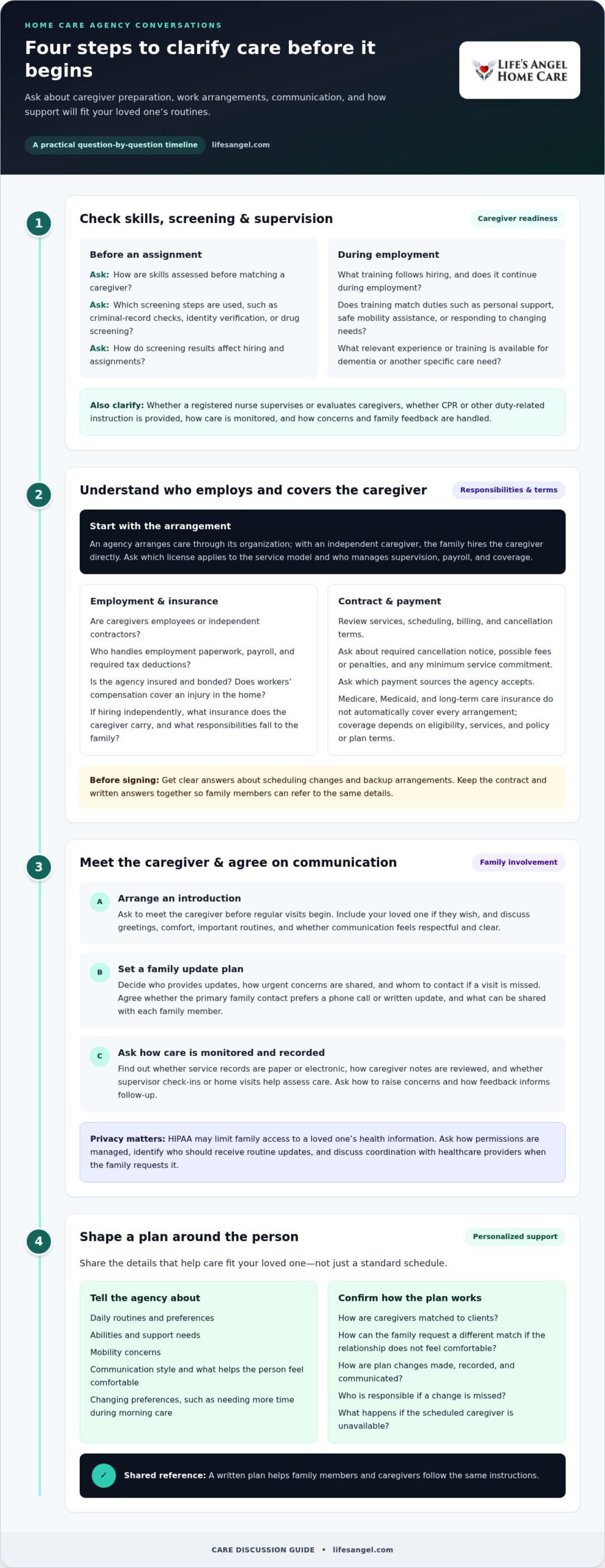
Ask how the agency assesses a caregiver’s skills before making an assignment. Then ask what training follows hiring and whether it continues during employment. Useful questions to ask home care agencies in NC include whether training reflects the duties involved, such as personal support, safe mobility assistance, or responding calmly when a client’s needs change. If your loved one has dementia or another specific care need, ask about relevant experience and training rather than assuming every caregiver has the same background.
Ask directly which screening steps the agency takes before hiring, such as criminal-record checks, identity verification, or drug screening. If these checks are part of its process, ask how results inform hiring and assignments. Specific answers help you understand the agency’s screening practices rather than relying on a general assurance that staff are carefully selected.
Ask how the agency monitors care after a caregiver is assigned. Find out whether a registered nurse supervises or evaluates caregivers and how concerns are addressed. Ask whether caregivers receive CPR training or other instruction relevant to their duties. Questions to ask home care agencies in NC can also cover how to share feedback and how it informs ongoing care.
Clarify whether caregivers are agency employees or independent contractors, and who handles employment paperwork. Ask whether the agency provides insurance and bonding for caregivers. If you’re considering an independent caregiver, ask how they handle Social Security, unemployment insurance, and federal and state taxes. The arrangement affects who manages these responsibilities, so get a clear explanation before care begins.
Ask how the agency matches caregivers to clients and handles backup arrangements. Explain your loved one’s routines, preferences, communication style, and support needs, then ask how these shape the care plan. Find out what happens if a scheduled caregiver is unavailable and how to request a different match if the relationship doesn’t feel comfortable. Clear answers help your family understand how care is arranged and changes are handled.
2. Are your professional caregivers employees or contract workers?
In North Carolina, a key practical difference is who hires and manages the caregiver. An agency arranges care through its organization, while a family hires an independent caregiver directly. Ask the agency which license applies to its service model and what responsibilities it takes on for supervision, payroll, and coverage.
Medicare, Medicaid, and long-term care insurance don’t automatically cover every home care arrangement. Coverage depends on each program’s eligibility rules, the services involved, and the policy or plan terms. Ask which payment sources the agency accepts, then compare the proposed care with the person’s benefits before making a financial plan.
Before signing a contract, review how it describes services, scheduling, billing, and cancellations. Ask how much notice is required to cancel, whether fees or penalties apply, and whether there is a minimum service commitment. Written terms help you understand what happens if care needs or family plans change.
Discuss insurance directly. Ask whether workers’ compensation covers a caregiver injured while working in your loved one’s home, and whether the agency is insured and bonded. These protections clarify who may be responsible if an incident occurs. If hiring independently, ask what insurance the caregiver carries and which responsibilities would fall to your family.
Ask how employment and oversight work after the agreement is signed. Find out whether caregivers are employees or contractors, who handles payroll and required tax deductions, and how the agency supervises care. If independent contractors are involved, ask who coordinates schedule changes and backup arrangements. Clear answers show how responsibilities are managed and can support continuity. Keep the contract and written answers together so family members can refer to the same details.
3. Can family members meet potential caregivers?
Ask to meet the caregiver before regular visits begin, with your loved one included if they wish. Use the introduction to discuss everyday preferences, such as how your family member likes to be greeted, what helps them feel comfortable, and which routines matter. The conversation can also show whether communication feels respectful and clear.
Agree on a family communication plan before care starts. Ask who will provide updates, how urgent concerns will be shared, and whom to contact if a scheduled visit is missed. Decide whether the primary family contact prefers a phone call or written update, and ask what information can be shared with each family member.
Privacy can affect those updates. HIPAA may limit family members’ access to information about a loved one’s health status, so ask how the care provider manages permissions and communication. Identify which family member should receive routine updates, and discuss how the agency coordinates with healthcare providers when the family requests it.
Ask how the agency monitors care and records changes. Find out whether it documents services in paper or electronic records, how to raise a concern, and how caregiver notes are reviewed. Ask whether supervisor check-ins or home visits help assess care, and how feedback from your loved one and family informs follow-up.
A care plan should reflect the person, not just a standard schedule. Invite your loved one and involved relatives to describe routines, mobility concerns, and changing preferences, such as needing more time during morning care. Ask how the plan is updated and how changes are communicated to the caregiver and family. Clarify who makes and records updates, and who is responsible if a change is missed. A shared written plan helps family members and caregivers follow the same instructions.
4. Home care services and customized care plans
A useful care plan begins with the person’s daily routine, abilities, and priorities. Ask how the provider identifies needed support, who contributes to the plan, and how tasks are recorded. Be specific about whether your loved one needs help dressing, moving safely around the home, or preparing meals. This helps distinguish wanted support from tasks the person can still manage independently.
Ask which home care services fit those needs and how the schedule can adapt as they change. A plan might combine personal care with mobility assistance, then adjust if your loved one needs more help getting ready in the morning. Clarify who reviews changes, communicates them to caregivers, and updates the written plan. This gives everyone a practical reference instead of relying on memory.
Ask whether nurses assess care needs and how the agency coordinates with the person’s doctor or other medical professionals. The patient’s physician directs the personalized care plan and nursing staff. Find out what information the agency uses, how the family can contribute observations, and which services are included in the plan. This helps clarify how daily support relates to the person’s medical guidance.
Ask how the provider distinguishes personal assistance from medical care, and how staff respond when needs go beyond the agreed tasks. You can also ask whether caregivers are licensed, bonded, and screened, then request a clear explanation of how those safeguards fit the agency’s process. Before signing, review a written plan or contract listing services and fees, and make sure it reflects your family’s understanding.
Hourly home care costs in North Carolina depend on the case and are provided after a quote request; factors include the services, schedule, and level of support needed. For help building a plan around everyday routines and personal care needs, explore personalized home care support.
Life’s Angel Home Care: Personal Care
Life’s Angel Home Care supports families when everyday tasks at home become harder to manage alone. Personal Care and Mobility Assistance help with daily routines and getting around, while Errand Assistance and Light Housekeeping can ease practical demands at home. This support can help your loved one maintain familiar routines with comfort and dignity.
Life’s Angel Home Care employs board-certified registered nurses, nursing assistants, and care aides who are BLS and CPR/AED certified. If personal support at home would help your family, visit lifesangel.com to learn more.
Take the Next Step at Your Family’s Pace
Choosing support is not just about filling a schedule. It’s about respecting your loved one’s preferences while easing pressure on family members. Use these questions to ask home care agencies in NC as a starting point, then focus on what would make an ordinary day feel safer, calmer, or more manageable.
The next step can be a simple conversation about the help your family needs. Life’s Angel Home Care offers Personal Care, Mobility Assistance, and Errand Assistance for situations where daily routines, getting around, or errands are becoming harder to manage. Share what matters most to discuss what support may suit your loved one.
When you’re ready to explore that possibility, contact Life’s Angel Home Care. You can take the decision one conversation at a time, with your loved one’s comfort at the heart of it.
Frequently Asked Questions
Do you have a nurse on staff?
Yes. Life’s Angel Home Care employs board-certified registered nurses, alongside nursing assistants and care aides. Ask how the nurse’s role relates to care coordination and other services. This helps clarify how nursing staff fit into the support your family is considering, without confusing home assistance with a medical treatment plan.
Who will be managing my loved one’s care?
Ask the agency to identify who coordinates your loved one’s support and serves as your main contact. Clarify who provides updates, addresses scheduling concerns, and communicates changes to caregivers. If your parent’s morning routine changes, knowing whom to tell helps keep family instructions and daily support aligned. Agree on a preferred way to share routine updates and urgent concerns.
Are your professional caregivers employees or contract workers?
Life’s Angel Home Care employs its registered nurses, nursing assistants, and care aides. Before care begins, clarify who handles scheduling, payroll, and communication if a caregiver’s assignment changes. Understanding the employment arrangement helps you know which organization coordinates the working relationship and where to direct practical questions about your loved one’s schedule or support.
Can family members meet potential caregivers?
Meeting before regular care begins gives your loved one and family a chance to share preferences face-to-face. Explain how your parent likes to be addressed, which routines matter, or what helps them feel at ease with someone new at home. Invite your loved one to take part and discuss how the family can share feedback afterward.
Can the caregiver drive my loved one to doctor appointments?
Life’s Angel Home Care offers Accompanied to Appointments and non-emergency transportation for healthcare visits. This can help when a loved one needs assistance getting to a doctor or dental appointment, rather than emergency transport. Share the appointment details and your family member’s mobility needs when planning, so the support and accompaniment are clear before the outing.
Can you or the agency provide proof the caregivers are insured and bonded?
Ask for written documentation explaining whether caregiver insurance and bonding apply and what they cover. Review the named insured party, coverage period, and any stated limits or exclusions to understand the protection described. Keep copies with your care agreement so family members can refer to the same information if questions arise about a visit or an incident at home.