

What if the first sign your loved one could use support isn’t a crisis, but a growing list of everyday tasks that feel harder to manage? Noticing changes can bring worry, especially when you want to protect their safety and dignity without taking away independence. Home care services can offer practical help that fits a person’s routine, from personal care and mobility assistance to meal preparation, light housekeeping, errands, companionship, and rides to appointments.
It’s understandable to wonder where everyday assistance ends and medical care begins, or how to balance caregiving with work and family life. You don’t have to solve everything at once. Start with your loved one’s daily routines and preferences, then identify specific tasks where help would make the day easier.
This guide offers a practical checklist for recognizing when extra help may be useful, understanding what home care can address, and preparing for a respectful conversation. It also explains how to consider safety, privacy, and independence as you plan a next step together.
Key Takeaways
- Notice which daily routines are becoming difficult, and record specific examples to identify where support could help.
- Understand how home care services can assist with everyday activities while recognizing when a need calls for another kind of care.
- Compare your loved one’s needs with specific tasks, schedules, and preferences to make care discussions practical.
- Use a simple sequence to plan respectfully: observe, discuss, prioritize, plan, and revisit.
- Explore how personal care, mobility assistance, meal preparation, and other everyday help may fit into a routine in Durham, Chapel Hill, and Raleigh.
Home care services: a checklist for noticing when everyday support may help
It can be hard to notice when a familiar routine is becoming more challenging, especially when you’re trying to respect your loved one’s independence. You may see a meal left unfinished, an errand put off, or more effort needed to move around the home. These observations aren’t a diagnosis or a reason to rush into decisions. They’re a starting point for understanding what help might feel useful and welcome.
Home care services provide practical support with everyday activities in a person’s own home. Support can fit around established routines and preferences, without taking over tasks the person can and wants to do independently. For a broader introduction to the types of help and people involved, see this Home care services overview.
As you think about daily life, look for repeated changes across several areas:
- Getting around: Does moving between rooms, standing up, or getting in and out of a chair seem to take more effort? Note where help might make a routine easier and what the person would prefer to do independently.
- Meals: Is preparing food becoming difficult, or are meals regularly skipped because planning and cooking feel tiring? Consider whether help with meal preparation would be welcome, and which parts of choosing or preparing food the person wants to keep doing.
- Errands and appointments: Are shopping, picking up essentials, or attending appointments being delayed? Write down which outings matter and whether the challenge is getting ready, transportation, or having someone accompany them.
- Household routines: Are everyday chores such as light tidying becoming harder to keep up with? Identify particular tasks rather than judging the home by how it looks.
- Social connection: Has it become harder to visit others or take part in familiar activities? Ask whether companionship or accompanied outings might help the person stay connected.
One difficult day alone doesn’t determine what level of help someone needs. Look for patterns and record observations in neutral terms: which task was difficult, when it happened, what help was offered, and how the person responded. For example, “the grocery trip was postponed twice this week” is more useful for planning than a broad judgment that someone “can’t manage.” Notes can help distinguish a temporary setback from a routine that may benefit from support.
What changes in everyday routines might be worth noticing?
Focus on what you can see, not on guessing why it is happening. Note that making lunch took longer, a usual shopping trip was postponed, or getting ready to leave required more assistance. When possible, ask what would make the task easier. A person may welcome help carrying bags while still wanting to choose what to buy and where to shop.
How can families start the conversation with care and respect?
Choose a private, unrushed moment and begin by listening. You might ask, “Which parts of your routine would you most like to keep doing on your own?” Then raise one specific possibility, such as help preparing a meal or getting to an appointment, instead of making decisions for them. A calm conversation leaves room for preferences and concerns. If the person isn’t ready to decide, agree on a small next step, such as talking again after you have both had time to think.
What home care services can include, and where their limits matter
Knowing what support can and can’t do helps families build a plan around real daily needs. Home care services focus on practical assistance in a person’s home, with attention to comfort, choices, and privacy. Discuss familiar routines, including which tasks the person wants to keep doing and where help would feel welcome.
Which daily activities may home care support?
Everyday assistance can take different forms. Personal care may help with regular grooming and getting dressed, while mobility assistance can support movement through daily routines. Companionship offers time for conversation or shared activities, and meal preparation for seniors can make mealtimes easier. For more details about senior meal preparation services in Durham, NC, explore how in-home meal help can fit your loved one’s routine. The person’s preferences should guide how support is offered, especially with private routines.
- Personal care: Assistance with everyday grooming or dressing, offered with respect for privacy and choice.
- Mobility assistance: A helping hand as the person moves through daily routines.
- Companionship: Conversation, company, or time spent sharing a familiar activity.
- Meal preparation: Help preparing meals in keeping with the person’s routine and preferences.
- Practical tasks: Errand assistance, light housekeeping, and accompanied appointments can help with parts of the day that are difficult to manage alone.
Be specific when describing the help that would be useful. Someone may appreciate help preparing a meal but prefer to choose the menu, or welcome assistance with an outing while deciding where to go. These details keep the person involved in their own care and give family members a clearer picture of what support should look like.
When is home care not a substitute for another kind of care?
Home care supports everyday activities; it is not emergency response, ambulance transportation, continuous skilled nursing, or inpatient hospice care. If someone may be experiencing an emergency, contact emergency services. For urgent or clinical concerns that are not an emergency, speak with an appropriate health professional.
This distinction helps families match a need to the right kind of support, rather than expecting an everyday caregiver to provide emergency or continuous clinical care. The U.S. Department of Health and Human Services offers broader information about long-term care options through its HHS Long-Term Care Resources.
For practical help with personal care, mobility, meals, companionship, errands, light housekeeping, or accompanied appointments, Life’s Angel Home Care provides support shaped around everyday routines. Learn more about in-home support from Life’s Angel.
How to compare home care options with your loved one’s needs
A useful comparison starts with the person, not a service list. Home care services can address particular daily tasks while allowing someone to remain in familiar surroundings, but the right fit depends on what support they want, how often they need it, and what feels comfortable. Include your loved one in the discussion so their priorities shape the plan.
Which questions help clarify the kind of support needed?
Ask which tasks feel difficult, which are still manageable, and what kind of help would be welcome. Then consider timing: is support needed occasionally, mainly for appointments, or as part of a regular routine? Your observations can help start the conversation, but your loved one’s preferences matter just as much. Discuss privacy, familiar habits, and how family members can coordinate without making the person feel overlooked.
This table can turn broad concerns into a practical family discussion. Adapt the examples to the person’s day rather than treating them as a fixed checklist.
| Need | Example task | Preferred help | Questions for family discussion |
|---|---|---|---|
| Getting around | Moving between rooms or preparing to go out | A steadying hand, or help only at particular moments | Where would support feel useful? What would the person prefer to do independently? |
| Meals and daily routines | Preparing a meal or keeping up with a familiar task | Help with one step while preserving the person’s choices | Which routines matter most? What assistance feels comfortable and respectful? |
| Appointments and errands | Getting to an appointment or completing an essential errand | Accompaniment or help with the outing | How often does this come up? Who will coordinate details with the person? |
| Connection and reassurance | Sharing conversation or a preferred activity | Companionship that fits the person’s interests | What helps them feel at ease? How do they like to spend time with others? |
Use the answers to identify the most important needs first. A short written plan can capture preferred routines, boundaries around private tasks, and who in the family will help coordinate. It can also highlight where relatives’ views differ from the person’s own, giving everyone a chance to listen before decisions are made. When comparing support options, consider whether the help covers the tasks identified, fits the person’s preferred schedule, and respects their choices about how each task is done.
How can families weigh home support against other care settings?
Home support and facility-based living are different arrangements, not automatic opposites. Consider the value of familiar surroundings alongside the person’s daily assistance needs, social preferences, and the family’s practical capacity to coordinate support. A setting that suits one person may not suit another, and needs can change. Compare what feels comfortable now, including which tasks can be supported at home, and leave room to revisit the plan if circumstances shift.
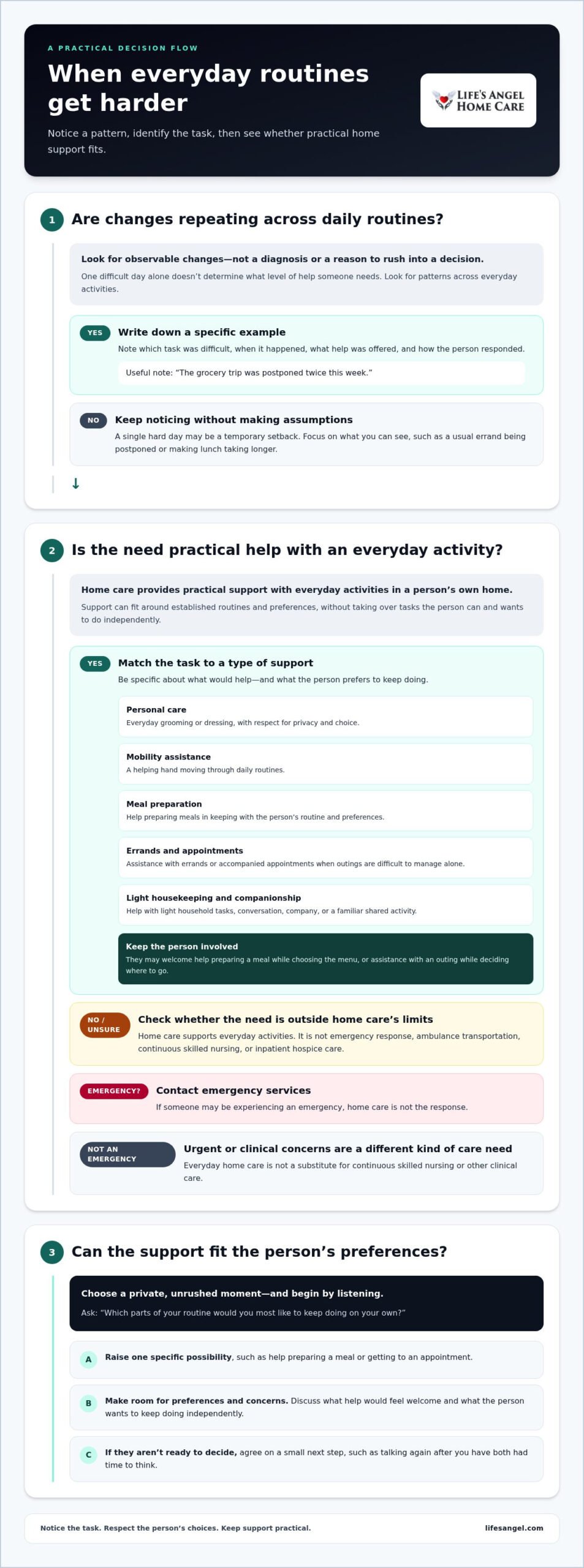
A family checklist for planning respectful home care
A thoughtful plan doesn’t need to be complicated. A simple sequence can help your family move from concern to practical next steps while keeping your loved one involved: observe what is changing, discuss preferences, prioritize the most important needs, plan who will do what, and revisit the arrangement as routines shift. Treat your notes as a guide, not a rigid set of rules.
What should families write down before arranging support?
Start with the person’s usual day. Note preferred routines, tasks they want to keep doing independently, and the kind of assistance that feels comfortable. Include practical details such as mobility considerations or whether accompaniment to appointments would help, but leave out private information that isn’t needed for planning. Invite your loved one to review and shape the notes so they reflect their perspective.
A short, clear record can help family members discuss needs without relying on memory alone. Consider noting:
- Daily preferences: Usual mealtimes, activities, and routines that matter to the person.
- Support priorities: Tasks where help would make the day easier, and tasks they prefer to manage themselves.
- Communication: How the person likes family members to share updates and discuss changes.
- Coordination: Who will organize appointment details, help communicate changing needs, and keep the family informed.
- Questions: Anything the person or family wants to understand before deciding on home care services.
A written routine helps everyone offer support in ways that reflect the person’s preferences, not just the family’s assumptions.
How can a care plan stay person-centered over time?
Set a family check-in to talk about what feels helpful and what may need adjusting. The person receiving support should have a voice in these conversations whenever possible, including the choice to change a preference or take on a task independently. Keep the plan flexible: a routine that works now may need a different approach later, and small updates can prevent old assumptions from guiding new decisions.
Use the checklist to organize family conversations, not to diagnose a concern or replace a professional assessment. If a question involves health or an urgent change, seek advice from an appropriate professional; urgent medical concerns need prompt attention. For everyday support, a written plan can make it easier to describe preferred routines and priorities as you explore options.
Life’s Angel Home Care provides in-home support shaped around daily routines, including personal care, mobility assistance, companionship, and help with practical tasks. Learn more about Life’s Angel Home Care and its everyday support.
Home care services in Durham and the Triangle: a gentle next step
Once your family has identified tasks that feel difficult and routines your loved one wants to preserve, exploring local support can be a calm next step. You don’t need every detail settled before starting a conversation. A few clear examples can explain what might make an ordinary day easier while leaving space for your loved one to say what feels right.
Life’s Angel Home Care is based in Durham and serves seniors and adults with disabilities in Durham and nearby Triangle communities, including Chapel Hill and Raleigh. Families can discuss the person’s usual routine, priorities, and specific tasks where assistance may help. Support is provided as hourly or scheduled-shift in-home assistance, shaped around the needs and preferences discussed.
What can a family discuss when exploring local support?
Bring a short list of tasks rather than trying to describe everything at once. You might explain that getting ready for the day takes more effort, an outing is difficult to manage alone, or meal preparation has become a concern. Share the kind of help your loved one welcomes, as well as the parts of the routine they want to continue independently.
Families can also discuss how assistance might fit around appointments or other familiar activities. Life’s Angel’s nursing assistants and care aides are BLS and CPR/AED certified. The team also includes board-certified registered nurses. These qualifications describe the people on the care team, but they don’t replace a discussion with an appropriate health professional about clinical concerns.
How can Life’s Angel support everyday life at home?
Life’s Angel Home Care provides practical help with everyday activities, including personal care, mobility assistance, companionship, errands, meal preparation, and light housekeeping. Support can also include accompanying someone to a healthcare appointment. This is scheduled, non-emergency assistance intended to help with the outing, not respond to an emergency.
Depending on the person’s needs, a useful starting point might be help with a particular task, company during part of the day, or support with an appointment. The goal is to shape care around personal choices and familiar routines, while recognizing that family caregivers also have work, family responsibilities, and limits of their own.
For families in Durham, Chapel Hill, and Raleigh, a conversation about daily routines and priorities can help make the next step clearer. Talk with Life’s Angel Home Care about practical in-home support for your loved one.
Take one thoughtful step toward support
You don’t have to map out every future need before beginning a conversation. Choose one everyday moment that has become harder, then ask your loved one what would make it feel more manageable. Starting with their perspective can turn uncertainty into a shared decision, with comfort, choice, and independence at the center.
Exploring home care services can also help family caregivers consider how support might fit alongside work, family life, and the routines everyone values. The first step can simply be talking through what matters most and what kind of help feels welcome. A plan can grow as preferences and needs become clearer.
Talk with Life’s Angel Home Care about everyday support and take a thoughtful next step with your family.
Frequently Asked Questions
Is home care only for older adults?
No. Life’s Angel Home Care supports seniors and adults with disabilities, and age alone doesn’t determine whether in-home help may be useful. Someone might welcome mobility assistance for getting around, companionship during the day, help preparing a meal, or support with errands. The key considerations are the individual’s everyday needs, preferences, and the tasks they choose to share with a caregiver.
Can home care help someone remain independent at home?
It may help someone keep familiar routines while receiving assistance with selected tasks, though it can’t guarantee a particular outcome or prevent a future move. For example, a person might want help carrying groceries but prefer to choose items and put them away themselves. Ask your loved one which tasks they’d like help with and which they want to continue doing independently, then use those preferences to guide a home care services plan.
How many hours of home care does a person need?
There’s no single number that suits everyone. The amount of support depends on daily routines, the tasks a person wants help with, personal preferences, and family circumstances. Life’s Angel provides hourly or scheduled-shift assistance, with no single schedule that applies to every person. Start by writing down tasks across a typical day, then discuss which ones feel difficult, when support might help, and what your loved one would welcome.
Does home care include transportation to medical appointments?
Yes. Life’s Angel offers scheduled, non-emergency transportation with personal accompaniment to and from healthcare appointments. This is not emergency ambulance transportation. As you plan, consider whether your loved one needs help reaching the appointment, someone to accompany them during the trip, or both. Sharing the appointment routine and the type of assistance preferred can help your family discuss what support is appropriate.
Can home care services help adults with disabilities?
Yes. Life’s Angel provides in-home personal support for adults with disabilities as well as seniors. Depending on the person’s needs and preferences, everyday help may include mobility assistance, personal care, companionship, or assistance with errands. The person’s choices should guide how support is offered and which tasks they want to manage themselves. Home care is not a substitute for continuous, live-in skilled nursing, and the right mix of assistance varies by individual.
What should I do if my loved one needs immediate medical help?
If your loved one may be experiencing an emergency, contact local emergency services rather than waiting for a scheduled caregiver or appointment. Home care is not emergency medical response or ambulance transportation. For a concern that isn’t an emergency, write down what has changed and when you noticed it, then discuss the concern with an appropriate health professional. You can separately consider whether everyday help with routines would be useful.