

Could a program help with caregiving costs while allowing you to direct care at home? In North Carolina, Home Care Independence allows an older adult to hire family, friends, or others as a caregiver or personal assistant, according to the North Carolina Division of Aging and Adult Services. If you’re looking for a home care aide for a disabled adult in Chapel Hill, this is one option to understand. It is intended for people whose needs can be safely met at home with informal caregivers.
It’s understandable to want support that eases daily responsibilities and financial strain while respecting your loved one’s routines and choices. This guide explains how North Carolina’s program works, who may qualify, and what it can and cannot cover, so you can assess whether it suits your family’s situation.
You’ll also learn what in-home assistance can look like for adults with disabilities, how consumer-directed care differs from agency support, and where personal care, mobility assistance, meals, and companionship can fit into a care plan.
Key Takeaways
- Learn how North Carolina’s Home Care Independence program supports eligible people who want to direct assistance with daily activities at home.
- See how caregiver arrangements can differ, and what to consider when matching support to an adult’s routines and needs.
- Understand how companionship and practical help can support everyday comfort while preserving personal choice.
- Explore how in-home assistance, including personal care and mobility help, may fit alongside Medicaid’s CAP/DA program.
Homemaking and personal care for seniors and people with disabilities
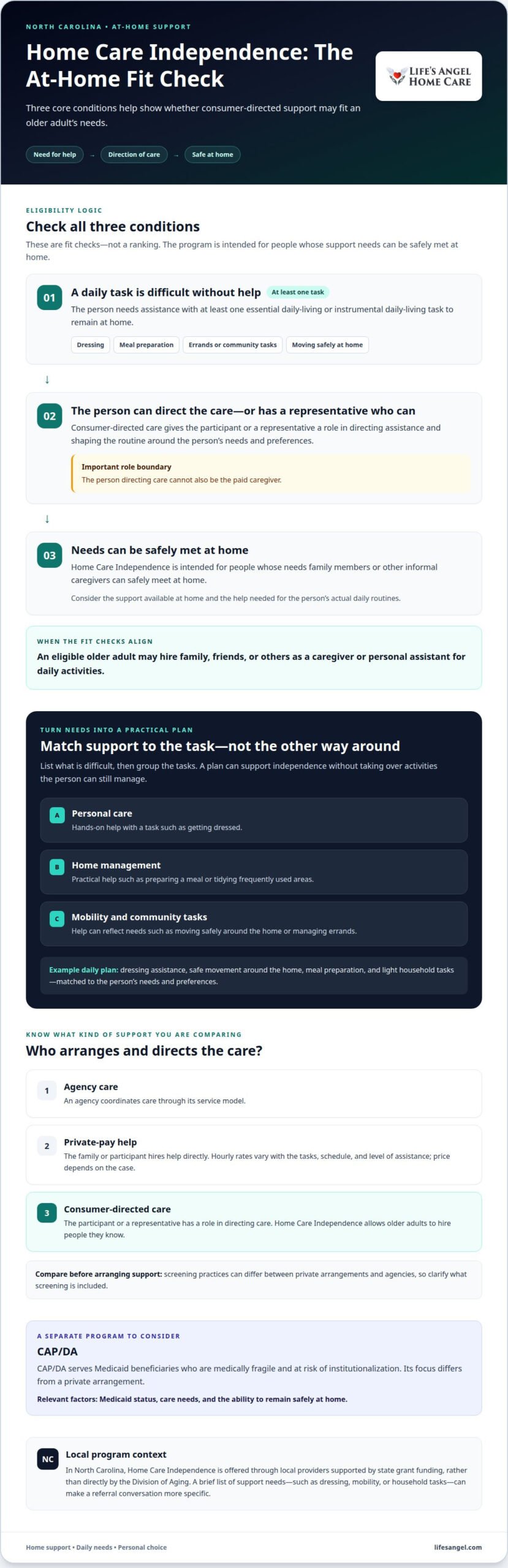
North Carolina’s Home Care Independence program connects eligible participants with personal assistants for daily activities. According to the North Carolina Division of Aging and Adult Services, an older adult may hire family, friends, or others as a caregiver or personal assistant. Assistance can include personal care and home management for people with functional, physical, or mental impairments. For example, support might include getting dressed, preparing a meal, or tidying frequently used areas.
To qualify, a participant must need help with at least one essential daily-living or instrumental daily-living task to remain at home. They must also be able to direct their care or have someone direct it for them. These needs shape the care plan: someone who struggles with dressing may need hands-on personal care, while someone who manages self-care but cannot run errands may need help with community tasks. Home Care Independence is intended for people whose needs family members or other informal caregivers can safely meet at home.
Agency care, private-pay aides, and consumer-directed services differ in who arranges and directs assistance. An agency coordinates care through its service model, while private-pay arrangements involve hiring help directly. Consumer-directed care gives the participant or a representative a role in directing care. North Carolina’s program allows older adults to hire people they know, which may help them maintain familiar routines.
Start by listing difficult tasks, then group them into personal care, home management, and mobility. A daily plan might include help with dressing, moving safely around the home, meal preparation, and light household tasks. This list clarifies where assistance can support independence without taking over activities the person can still manage. For seniors and younger adults with disabilities, match services to actual daily needs, preferences, and the support available at home.
Special-needs adult caregiver listings in Chapel Hill
Local caregiver listings can help families compare experience and approaches to support, while program eligibility determines which care arrangements may fit. For Chapel Hill residents seeking referrals, North Carolina’s Home Care Independence program is offered through local providers supported by state grant funding, rather than directly by the Division of Aging.
Caregiver and Service Eligibility
Eligibility depends on the adult’s support needs and how care will be directed. Under North Carolina’s Home Care Independence program, participants need help with at least one daily-living or instrumental daily-living task to remain at home, and must be able to direct care or have someone do so. The person directing care cannot also be the paid caregiver.
Another option, CAP/DA, serves Medicaid beneficiaries who are medically fragile and at risk of institutionalization. Its focus differs from a private arrangement, so consider the person’s care needs, Medicaid status, and ability to remain safely at home when reviewing options.
Background Checks and Hourly Rates
Caregiver listings can describe experience, but a profile alone may not show how a person approaches safety or communicates. For example, Chapel Hill listings include caregivers with 10 years of special-needs care experience and another with one year. Compare relevant experience with the adult’s daily support needs, then discuss how the caregiver would provide caring, respectful assistance.
Private-pay hourly rates vary depending on the tasks, schedule, and level of assistance. The price depends on the case and is provided after a quote request; the type and amount of support are key cost factors. Screening practices can differ between private arrangements and agencies, so understand what screening is included before care begins.
Local Disability Care Referrals
Chapel Hill families can start by learning about North Carolina’s Home Care Independence program and its local provider network. A care advisor can help participants consider options and direct their own care. CAP/DA may be relevant for eligible Medicaid beneficiaries with complex needs.
Prepare a brief description of the adult’s support needs, such as help with dressing, mobility, or household tasks. This gives a referral conversation a clear starting point and helps connect the family’s priorities with an appropriate home care service.
Companion care
Companionship can make daily routines feel more connected, especially when disability limits opportunities to socialize. A visit might include conversation over lunch, a card game, or enjoying a favorite hobby at home. Ask what the adult enjoys, what feels tiring, and whether they prefer quiet company or an activity. These choices make support personal rather than one-size-fits-all.
Community outings can bring familiar interests beyond the front door. A companion might accompany someone to a county library event, a community center gathering, or a nearby park, depending on the person’s preferences and mobility. Before going out, agree on the destination, pace, and assistance that would help. Someone who enjoys reading, for example, might prefer a short library visit to a crowded event.
Companionship may also give a family caregiver time for a planned task, such as grocery shopping or cleaning, while the adult enjoys company at home. That practical pause is not necessarily a formal respite-care program. Clarify the visit’s purpose: social connection, an activity, or supervision while a family member steps away. A shared plan ensures everyone understands the role and keeps the adult’s wishes central.
Make visits meaningful by starting with a simple routine and adjusting it together. A family member can note conversation topics, preferred games, or signs that the person would like a quieter activity. The companion can offer choices rather than direct the day, asking, for example, whether the adult would rather listen to music or work on a puzzle. A familiar rhythm can support comfort without turning companionship into a checklist.
For someone who feels isolated, a steady social connection can be a valuable part of daily life. When planning support, families can describe the adult’s interests, communication preferences, and mobility needs. This gives a companion useful context and helps the adult feel respected at home and in the community. The aim is simple: spend time together in ways the person enjoys.
In-home care for adults with disabilities
For adults with disabilities, home support works best when it reflects the person’s daily priorities. Start with three areas: tasks that need assistance, routines the adult wants to keep, and support family members can provide. A plan might identify dressing as a daily challenge while preserving the person’s choice of clothing and morning schedule. This makes independence a practical goal, not an all-or-nothing measure.
North Carolina’s Community Alternatives Program for Disabled Adults, or CAP/DA, is a Medicaid home- and community-based waiver program. It offers a cost-effective alternative to institutionalization for Medicaid beneficiaries who are medically fragile and at risk of institutionalization. Eligibility and care needs matter when considering this route. A family member can organize questions around the adult’s daily activities, current support, and goal of remaining at home.
Home-based assistance and ongoing clinical oversight are not interchangeable. North Carolina’s Home Care Independence service is intended for needs that family members or other informal caregivers can safely meet at home. It does not replace facility-based services when someone needs ongoing care, supervision, or monitoring by a health care professional. This distinction helps families match the setting to the level of support required.
Turn the person’s priorities into a practical outline. Note which personal care services would help, what the adult can do independently, and whether errands such as shopping are a barrier. Include preferences, such as completing a familiar morning routine before assistance begins. A compassionate, attentive caregiver can use these details to offer respectful support without taking over tasks the person prefers to manage.
If you’re considering support with personal routines at home, discuss in-home care options that may fit your family member’s needs.
Life’s Angel Home Care
Life’s Angel Home Care provides in-home support for adults with disabilities when daily routines become difficult to manage alone. Personal Care can help with everyday needs, while Mobility Assistance supports moving around the home. Errand Assistance and Light Housekeeping can ease practical tasks that might otherwise fall to a family member.
Consider which parts of the day feel most challenging, such as moving around safely, running errands, or keeping up with light household tasks. Sharing these priorities can clarify what assistance may help and how it could fit into your loved one’s routine.
If you’re considering home support for someone you care about, contact Life’s Angel Home Care to discuss your family’s needs.
Take the next step toward support that fits
Choosing a home care aide for a disabled adult in Chapel Hill can start with one useful question: which parts of the day could be easier without taking away personal choices? A calm conversation with your loved one can clarify what they want to keep doing and where support could help. This keeps their voice at the center of decisions.
Life’s Angel Home Care provides Personal Care, Mobility Assistance, and Errand Assistance for daily routines. Share the priorities you’ve identified and discuss what in-home support could suit your household. You don’t need to have every answer before starting the conversation.
As routines change, revisiting those priorities can keep decisions centered on dignity, comfort, and independence. For a thoughtful conversation about support for your family, contact Life’s Angel Home Care. A steady next step can make the path ahead feel more manageable.
Frequently Asked Questions
Can I Get Help to Pay for Caregiving?
North Carolina’s Home Care Independence program lets older adults hire family, friends, or others as personal assistants, according to the North Carolina Division of Aging and Adult Services. The program is offered through local providers supported by state grant funding. CAP/DA is another option for eligible Medicaid beneficiaries who are medically fragile and at risk of institutionalization. The programs have different eligibility requirements and care arrangements.
Can I Get Help While Living In My Home?
Yes, some North Carolina programs support people living at home. Home Care Independence is intended for people whose needs can be safely met by family members or other informal caregivers. It does not replace facility-based services for someone who needs ongoing care, supervision, or monitoring by a health care professional. Consider the level of support needed to remain safely at home.
How do I access the service?
For Home Care Independence, start with a local provider offering the program; a care advisor can help participants consider options and direct their own care. If you’re seeking private in-home assistance, describe the person’s daily priorities and the help that would make routines easier. Life’s Angel Home Care can discuss support with mobility, personal care, and errands.
What else should I consider?
Consider the adult’s preferences, communication style, and comfort with different caregivers, as well as the tasks that need support. Someone may want help getting ready for an appointment but prefer to choose their own clothing and schedule. Also distinguish routine in-home assistance from care requiring ongoing professional monitoring. This helps families determine whether home support matches the person’s needs.
What steps do you take to ensure my senior loved one is safe at home?
Life’s Angel Home Care’s staff includes board-certified registered nurses, nursing assistants, and care aides. Its medical staff are BLS and CPR/AED accredited through the American Heart Association. When discussing care, share relevant mobility concerns, daily routines, and difficult tasks, such as moving around the home. This keeps the conversation focused on practical support without promising a particular safety outcome.
What home care services are available for disabled adults in Chapel Hill, NC?
For families seeking a home care aide for a disabled adult in Chapel Hill, support can include Personal Care, Mobility Assistance, Errand Assistance, Light Housekeeping, Companionship, and Meal Preparation. Life’s Angel Home Care also provides Accompanied to Appointments. For example, someone might need help getting ready to go out, preparing a meal, or having company during a trip to an appointment.