

The best in home caregiver durham nc families choose isn’t necessarily the one with the longest list of duties. It’s the person whose support fits everyday moments that matter, from getting ready in the morning to preparing a meal or going to an appointment. If you’re unsure what help your loved one needs or how to welcome someone new into the home, start by identifying the tasks that feel hardest and the routines they want to keep.
You don’t have to figure it all out at once. Comparing care by daily tasks, timing, and family priorities can make the next step clearer. This guide explains common caregiver tasks, how family-led, independent, and agency support can differ, and how to organize your household’s priorities. You’ll also learn about Life’s Angel Home Care’s team of board-certified registered nurses, nursing assistants, and care aides, and its in-home support in Durham.
Key Takeaways
- Compare caregiver support by the everyday tasks your loved one needs help with, not by job title alone.
- Consider how family-led help, an independent caregiver, and agency support differ in coordination, qualifications, and communication.
- Use a checklist to organize priorities, preferred timing, and routines your loved one wants to preserve.
- Learn how an in home caregiver durham nc can support daily life through practical help tailored to household needs.
- Explore how Life’s Angel Home Care provides hourly or scheduled-shift support for seniors and adults with disabilities in Durham.
What to look for in an in-home caregiver in Durham, NC
Looking for help at home can bring relief, but it can also raise personal questions: What kind of support would help? Will it respect your loved one’s privacy and choices? You don’t need to have every answer before exploring care. Begin with specific observations about daily life and the tasks that would make the day more manageable.
An in-home caregiver provides practical support in a person’s familiar home setting, helping with everyday tasks while respecting their comfort, routines, and independence. For families considering an in home caregiver durham nc, compare the assistance needed, the routines that matter, and the timing that would work for the household. In Durham, North Carolina, as elsewhere, the right arrangement depends on the individual and family, not a one-size-fits-all checklist.
Which everyday needs might prompt a family to seek support?
Notice changes in routines without jumping to conclusions about their cause. Getting dressed may take longer, moving around the home may feel less comfortable, or preparing a regular meal may become difficult. Errands might be left undone, household tasks may pile up, or a family member may struggle to balance caregiving with work and other responsibilities. These examples can help clarify where practical assistance might be useful.
Write down concrete tasks, such as help with morning personal care, mobility around the home, meal preparation, light housekeeping, or accompanied trips to appointments. A specific list makes it easier to compare arrangements and explain what would help, without assuming that every part of the day needs assistance.
What does a good caregiver fit mean for your family?
A good fit respects the person’s preferences as well as the family’s practical needs. Consider how your loved one likes to start the day, which tasks they prefer to do privately, and what familiar routines bring comfort. Include them in the conversation as much as possible so they can help shape how support fits into their home.
Separate tasks that need support from those your loved one still manages. They may welcome help preparing lunch but prefer to choose what to eat, or need mobility assistance while continuing to handle other parts of their routine independently. Assistance and independence can work together when help is offered respectfully and personal choices remain central.
Before comparing caregiver titles or arrangements, ask: Which moments of the day are hardest? What support would ease pressure without disrupting valued routines? When would help be most useful? The answers give your family a practical starting point for finding care that feels comfortable at home.
Match in-home caregiver support in Durham to everyday tasks
Once you’ve identified where the day feels difficult, connect each need to a specific kind of practical help. A recurring task list helps you distinguish regular support from occasional assistance and describe what would be useful. For an in home caregiver durham nc, the right mix should reflect the person’s routines, not an assumption that every household needs the same services.
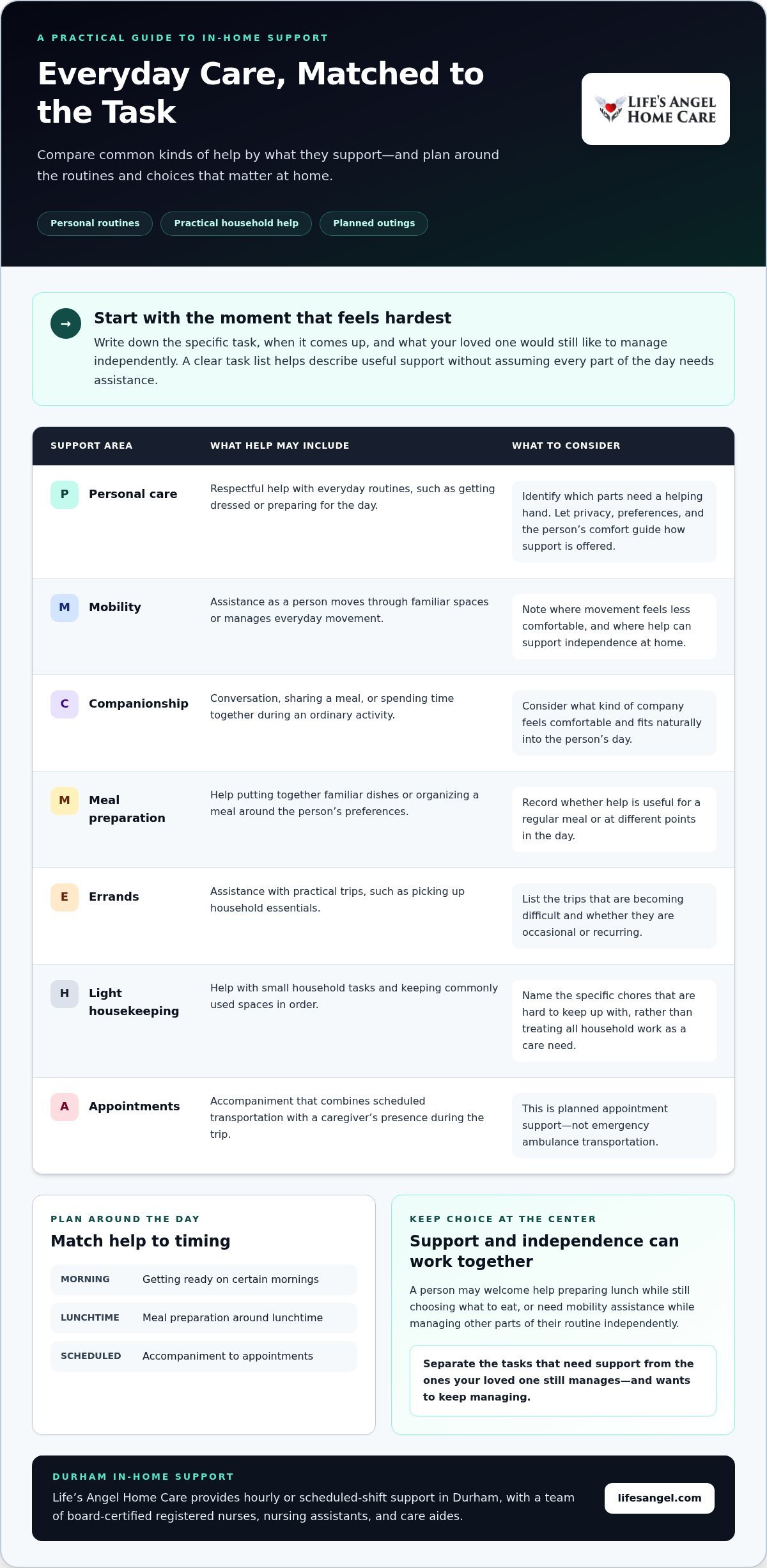
In-home caregiver support can include personal care, mobility assistance, companionship, meal preparation, errands, light housekeeping, and accompanied trips to appointments.
Personal care, mobility, and companionship at home
Personal care can include respectful help with everyday routines such as getting dressed or preparing for the day. Mobility assistance supports a person as they move through familiar spaces or manage everyday movement. The person’s privacy and preferences should guide how help is offered. A caregiver can assist while allowing them to do the parts they can and want to manage themselves. When comparing personal care services, identify which parts of the routine need a helping hand.
Companionship may involve conversation, sharing a meal, or spending time together during an ordinary activity. Light housekeeping can help with small household tasks and keeping commonly used spaces in order. When considering this support, list the specific chores that have become difficult to keep up with, rather than treating all household work as a care need.
Meals, errands, and accompanied appointments
Meal preparation may mean helping put together familiar dishes or organizing a meal around the person’s preferences. Note whether support is useful for one regular meal or at different points in the day. Families looking more closely at this task can explore the senior meal preparation guide.
Errand assistance can help with practical trips such as picking up household essentials. Accompanied appointment support combines scheduled transportation with a caregiver’s presence during the trip. This is planned assistance for appointments, not emergency ambulance transportation.
To turn broad concerns into a clear description, jot down recurring tasks and when they come up. For example, a family might note help getting ready on certain mornings, meal preparation around lunchtime, or accompaniment to scheduled appointments. This makes it easier to discuss what fits the household without treating every task as a daily need.
Life’s Angel Home Care provides hourly or scheduled-shift in-home support in Durham. Use your task list to identify the assistance you’re considering and how it could fit into the household routine. Explore Life’s Angel’s in-home support.
Compare in-home caregiver and agency support in Durham
Choosing support also means deciding how care will be organized. Family-led help, an independent caregiver, and agency-based support can each suit different household circumstances. Compare how each arrangement handles task expectations, schedules, and communication, while keeping your loved one’s comfort and preferences at the center.
What can families compare across care arrangements?
Consider who will keep track of the routine, how tasks will be described, and how changes in needs or timing will be shared. A written list of priorities helps everyone discuss the same expectations, whether a relative is coordinating help or support is arranged through an independent caregiver or agency. Focus on the actual tasks and schedule, rather than choosing by title alone.
| Arrangement | Coordination and communication | Qualifications and task fit |
|---|---|---|
| Family-led help | Relatives usually organize the schedule, divide tasks, and share updates among themselves. | Support may reflect close knowledge of the person’s preferences. Families can identify which tasks relatives can manage and where additional help may be useful. |
| Independent caregiver | The household and caregiver generally discuss timing, duties, and changes directly. | Experience and qualifications depend on the individual. Clear expectations help align agreed tasks with the person’s needs and routines. |
| Agency-based support | Families communicate care needs and schedule preferences through the agency’s process. | Team roles and qualifications vary by agency. Life’s Angel Home Care employs board-certified registered nurses, nursing assistants, and care aides. Its nursing assistants and care aides are BLS and CPR/AED certified. |
How does an agency team differ from one caregiver?
With agency-based support, in-home assistance is organized through a care team and the agency’s process. With one independent caregiver, the household communicates directly with that person. The arrangements differ in how tasks and schedules are discussed, so consider which approach suits your family’s communication needs. Life’s Angel provides hourly or scheduled-shift in-home support, and its team roles and qualifications give families concrete details to consider.
It’s understandable to think carefully about whom you welcome into a loved one’s home. Credentials are one part of the decision. Consider them alongside the person’s preferences, the specific assistance needed, and how care expectations will be communicated. For a family seeking an in home caregiver durham nc, this comparison can make the options easier to discuss without assuming one arrangement suits everyone.
To connect your preferred schedule and support tasks with a care arrangement, learn about Life’s Angel’s hourly or scheduled-shift in-home care.
Use a practical checklist to choose caregiver support in Durham
Care needs can be hard to explain when they’re part of a busy, changing routine. A short checklist can move the conversation from general concerns to specific support. Include your loved one where possible, and note the routines and choices they want to keep.
Use these four steps to organize your family’s thoughts:
- List daily tasks. Write down where help may be useful, such as getting ready, preparing a meal, or keeping up with a household routine. Describe what’s happening without assuming every task needs assistance.
- Set priorities. Separate essential support from helpful extras. Mark which needs come up regularly and which are occasional, so the conversation starts with what matters most to your loved one and family.
- Note preferred timing. Record when support would be most helpful without deciding in advance that a particular schedule is required. Note whether a task is tied to a morning routine, a meal, or an appointment.
- Discuss the support. Share the task list, priorities, and timing preferences with your family and care agency. Include your loved one’s preferences and describe how they’d like assistance to be offered.
How can families describe care needs clearly?
For each priority, note the task, its usual timing, and what respectful help looks like to the person. For instance, explain whether they prefer a reminder, hands-on assistance, or time to try a task independently first. Keep the summary focused on details that clarify the support being discussed.
This simple format helps distinguish essential assistance from optional help. It also gives the person receiving care a voice in how support fits into their home and daily life.
How should families think about schedules and changing needs?
Some needs follow a steady routine, while others arise occasionally or shift over time. Life’s Angel Home Care provides hourly or scheduled-shift assistance. Share your current routine and the support you’re seeking to make the conversation about a suitable care arrangement more specific.
A checklist is a starting point, not a promise that needs or timing will stay fixed. Keep it easy to update as family schedules and preferences change. If you’re considering an in home caregiver durham nc, use your task list and preferred timing to discuss support that aligns with your family’s priorities. Discuss your family’s in-home care needs.
Explore Life’s Angel in-home caregiver support in Durham, NC
A care arrangement feels more personal when it starts with the life your loved one already knows. The routines they value, the tasks that feel difficult, the times support would help, and the way they prefer assistance to be offered all belong in the conversation. These details help your family consider care that respects the person, not just a list of duties.
Life’s Angel Home Care provides in-home support for seniors and adults with disabilities in Durham, Chapel Hill, and Raleigh. Families can consider hourly or scheduled-shift assistance and connect it to their priorities, whether those involve a daily routine, household help, or companionship. This practical support can help families discuss what assistance may fit while keeping familiar routines and preferences in view.
What families can expect from Life’s Angel’s support
Support takes place in the person’s home and can be organized around the practical needs a family identifies. Care includes personal care, mobility assistance, companionship, meal preparation, errands, light housekeeping, and accompanied transportation to appointments. The focus is everyday assistance, with the person’s preferences and familiar routines guiding how help fits into the day.
Knowing who is part of the care team can help families compare arrangements. Life’s Angel employs board-certified registered nurses, nursing assistants, and care aides. Nursing assistants and care aides are BLS and CPR/AED certified. These roles and qualifications offer useful context when discussing in-home support; individual duties depend on the assistance being arranged.
For families looking for an in home caregiver durham nc, start with the combination of needs and preferences: what assistance matters, which routines should remain familiar, and what kind of schedule the household is considering. Those details make an initial discussion more specific and personal.
What is a useful first conversation about care?
You don’t need a perfect plan before talking about care. Begin with a simple summary: describe your loved one’s usual routine, identify the tasks that matter most, and share how they prefer support to be offered. Note whether needs are regular or occasional, and include routines they want to preserve. Keep the conversation focused on care-related details while respecting personal privacy.
It can also help to explain the family’s current schedule and the assistance you’re exploring. Life’s Angel’s hourly or scheduled-shift support gives families a practical basis for discussing timing and care needs, even if every future detail is not yet settled. The conversation can focus on current priorities and the support that would fit.
If you’re ready to discuss the routines and support that matter to your family, talk with Life’s Angel about in-home care.
Take the next step toward care that feels right
Choosing support doesn’t mean giving up the familiar parts of home life. It can help preserve the routines and choices your loved one values while adding assistance where it’s needed. Begin with one small step: talk together about what would make an ordinary day easier and what should stay just the way it is.
If you’re exploring an in home caregiver durham nc, let your family’s priorities guide the conversation. Needs may shift, and the first discussion doesn’t have to settle every detail. It can help you consider a comfortable path forward with your loved one’s dignity and preferences at the center.
Start a care conversation with Life’s Angel and share what matters most to your family.
Frequently Asked Questions
What does an in-home caregiver do for seniors in Durham, NC?
An in-home caregiver helps with practical tasks that make everyday life at home more manageable. Support might involve getting ready for the day, preparing a meal, or keeping up with small household routines. The right combination depends on the person’s needs and preferences. If you’re considering an in home caregiver durham nc, think about which parts of a typical day feel difficult and what kind of help your loved one would welcome.
How do I choose an in-home caregiver for my parent in Durham?
Start by talking with your parent about what feels difficult and what help they’d be comfortable accepting. Then write down the tasks, preferred timing, and routines they’d like to preserve. For example, your parent might want support with a morning routine but prefer to choose their own meals. Use these details to compare how care arrangements coordinate support and communicate changes, while keeping your parent’s wishes central.
Can an in-home caregiver help with errands and doctor appointments?
Yes. In-home caregiver support can include errands and scheduled transportation with personal accompaniment to healthcare appointments. Before discussing these needs, note common destinations, appointment routines, and whether your loved one prefers someone to accompany them throughout the trip. This is planned appointment support, not emergency ambulance transportation. A clear description of the trip helps your family discuss what assistance would feel comfortable and practical.
How many hours of in-home care can a family arrange?
The amount of support depends on the tasks and routine your family wants to discuss. Life’s Angel provides assistance hourly or on scheduled shifts, so a useful starting point is to note when help may be needed and whether tasks are recurring or occasional. For example, distinguish regular household support from accompaniment for an appointment that comes up periodically. This gives the care conversation context without assuming one schedule fits every family.
Is in-home caregiver support the same as 24/7 live-in skilled nursing?
No. Everyday in-home caregiver assistance and 24/7 live-in skilled nursing are different arrangements. Life’s Angel provides hourly or scheduled-shift support for practical routines and personal care at home. If your loved one has particular care needs, describe the help they’re looking for and the tasks involved. Being specific helps your family discuss the kind of support under consideration without assuming that all home care includes continuous skilled nursing.
Are Life’s Angel caregivers available in Chapel Hill and Raleigh?
Life’s Angel Home Care serves Durham, Chapel Hill, and Raleigh. As you consider support in these communities, note details that affect the routine, such as the usual timing of an appointment or which household tasks are most pressing. Keeping the focus on your loved one’s preferences and the practical help they want can make a conversation about in-home care more useful.
How are in-home caregiver services scheduled and billed?
Life’s Angel bills for in-home assistance hourly or on scheduled shifts, with the arrangement based on your family’s care needs and routine. Appointment support includes transportation and personal accompaniment for scheduled trips. To make a billing conversation more focused, prepare the tasks you’re considering and when they typically occur.