

What if accepting help could protect your parent’s independence rather than take it away? If you’re considering non medical care for elderly parents, you may be wondering what a caregiver can actually do and how support at home can respect your parent’s routines and choices. When you’re also balancing work, family, and distance, handling every daily need yourself can be difficult to sustain.
Non-medical home care offers practical help with everyday tasks while leaving room for your parent to make decisions and stay involved. Support may include personal care, mobility assistance, meal preparation, light housekeeping, companionship, errands, or rides to appointments. The right arrangement can ease pressure on family members without asking your parent to give up the comforts of home or the parts of daily life they value.
This guide explains what non-medical care can include, how to recognize recurring challenges, and how to discuss support with care and respect. You’ll also find practical ways to match assistance to your parent’s preferences and share responsibilities across the family. For families in Durham, Chapel Hill, and Raleigh, in-home support can be one part of a thoughtful plan.
Key Takeaways
- Non medical care for elderly parents can offer personal and social support while keeping your parent involved in everyday decisions.
- Look for recurring routines that have become difficult, rather than relying on age or a diagnosis alone to decide whether support may help.
- A thoughtful care plan starts with listening, setting priorities, and agreeing on routines that work for your parent and family.
- Clearly shared responsibilities can help relatives coordinate support without placing the full burden on one person.
- Life’s Angel Home Care supports older adults at home with personal care, mobility assistance, companionship, and meal preparation.
What Does Non-Medical Care for Elderly Parents Mean?
Arranging help for a parent can stir up complicated feelings. You may want them to remain safe and comfortable, while worrying that bringing someone into the home could feel like a loss of privacy or control. It helps to start with a clear purpose: make everyday life easier without taking over decisions your parent can still make.
Non-medical care is practical, personal, and social support at home that helps someone manage daily life without providing clinical diagnosis or treatment. For a parent who lives alone, that could mean assistance with personal routines, meal preparation, moving around the home, light housekeeping, errands, or friendly company. Support can focus on a particular task or part of the day, based on what your parent finds useful.
The broad overview of Home care describes support provided in a person’s home, including assistance distinct from home health care. In practical terms, non-medical care focuses on daily living rather than assessing symptoms, treating an illness, or making clinical decisions. A person may receive everyday assistance and clinical care at the same time, with each addressing different needs.
How non-medical home care differs from medical care
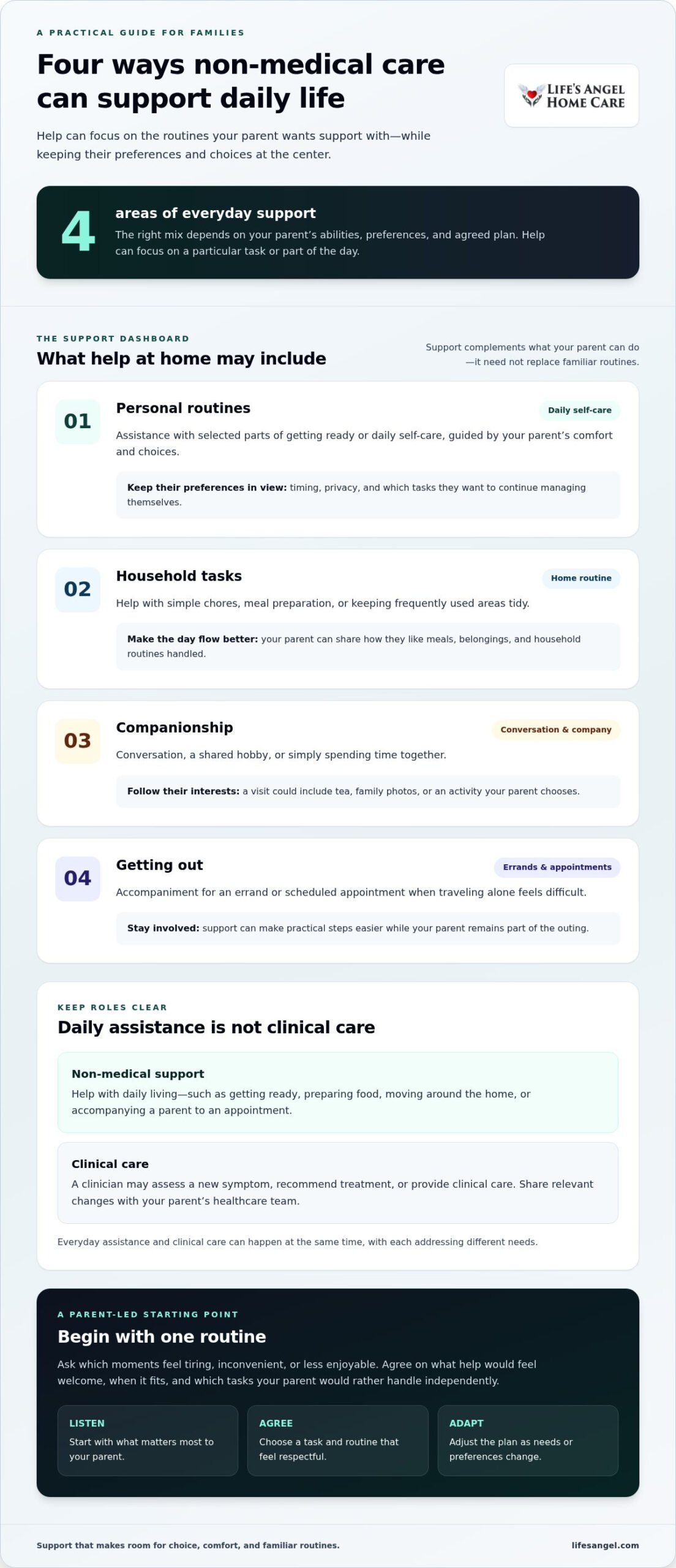
Think of the difference as help with a routine versus treatment for a health concern. A caregiver might help a parent get ready for the day, prepare food, or accompany them to an appointment. A clinician, by contrast, may assess a new symptom, recommend treatment, or provide clinical care. These needs can overlap: a parent may benefit from practical help at home while also receiving care from a doctor or other clinician. Keep each role clear and share relevant changes with your parent’s healthcare team.
Why families consider support at home
When everyday tasks become harder, relatives often step in around work, caregiving, and distance. Support with agreed-upon routines can share that responsibility and leave more time for family members to simply spend time together. It doesn’t automatically mean a parent has less independence. Your parent can help decide what assistance feels welcome, when it fits, and which tasks they prefer to handle on their own.
Familiar surroundings can also feel reassuring. A parent can keep cherished routines, belongings, and the rhythm of home while accepting help with specific tasks. Start with what your parent says matters most. They may want help preparing meals but prefer to manage their morning routine, or welcome company on an errand without handing over household decisions. Listening first makes support more personal and gives your parent a meaningful role in shaping it.
That’s the heart of non medical care for elderly parents: help with daily living that can adapt to a person’s abilities and preferences. It isn’t an all-or-nothing choice between doing everything alone and giving up control. Begin by identifying one practical challenge, discussing what kind of assistance would feel respectful, and adjusting the plan as needs or preferences change.
What Can Non-Medical Care for an Elderly Parent Help With?
Support at home can focus on the parts of the day your parent wants help with, rather than replacing routines they still manage comfortably. For families exploring non medical care for elderly parents, it helps to consider four areas: personal routines, household tasks, companionship, and getting out. The mix depends on your parent’s abilities, preferences, and agreed plan. Assistance should complement what they can do, not assume every task is needed or that every caregiver provides the same help.
Ask your parent which moments feel tiring, inconvenient, or less enjoyable than they used to. They may welcome support with one task and prefer privacy with another. Respecting those choices can make help feel more natural and keep familiar habits at the center of the day.
Everyday routines and practical help at home
Personal routines and household tasks are easier to discuss when you focus on what would make the day flow better. Depending on the arrangement, a caregiver may help with getting ready, moving around familiar spaces, preparing food, or keeping frequently used areas tidy. Your parent can set preferences such as when they like to eat, how they organize belongings, and which tasks they want to continue doing independently. Agreeing on those details helps protect privacy and comfort.
- Personal routines: Assistance with selected parts of getting ready or daily self-care, guided by your parent’s comfort and choices.
- Household tasks: Help with simple chores or meal preparation that makes the home routine more manageable.
- Companionship: Conversation, a shared hobby, or simply spending time together.
- Getting out: Accompaniment for an errand or scheduled appointment when traveling alone feels difficult.
Companionship and help beyond the home
Friendly company can bring conversation and shared activity into an otherwise quiet day. A visit might include talking over a cup of tea, looking through family photos, or enjoying an activity your parent chooses. This is everyday interaction, not clinical treatment. For an outing, accompaniment can make the practical steps of an errand or appointment easier while allowing your parent to stay involved. Families planning errands can also explore this senior errand service guide.
For example, a caregiver might help your parent get ready, prepare lunch with them, and accompany them on an errand before sharing conversation at home. That is an illustration, not a fixed schedule. Your parent may want just one kind of help or a different combination on different days. The plan should reflect what feels useful to them.
Families in Durham, Chapel Hill, and Raleigh can consider in-home support from Life’s Angel Home Care to share everyday responsibilities while keeping a parent’s preferences in view.
Does Non-Medical Home Care Fit Your Parent’s Needs?
There isn’t one age or diagnosis that determines whether a parent could use help at home. A more useful question is whether everyday tasks are becoming difficult often enough to affect their routine, or whether family members are carrying more support than they can comfortably sustain. Non medical care for elderly parents may be worth discussing when practical challenges recur, even if your parent remains active and manages many parts of life independently.
Notice patterns rather than treating one difficult day as a verdict. A missed grocery trip, a chore repeatedly put off, or a routine that leaves your parent unusually tired can be a reason to check in. These observations aren’t diagnostic criteria; they’re openings for conversation. Try asking, “Which part of the week feels like the most work?” or “Would help with this task make things easier?” Then listen before suggesting a solution.
Changes in daily routines that may prompt a family conversation
Look for changes in how your parent manages errands, meals, household tasks, or getting around during familiar activities. You might also notice they’re relying on relatives more often for tasks they used to handle themselves. Consider whether the difficulty happens repeatedly and what your parent says about it. Keep the conversation specific and respectful, and focus on the help they would welcome rather than taking over the whole routine.
It can help to separate the task from the fear attached to it. Instead of saying, “You can’t manage alone,” try, “Would it help if we planned support for the grocery trip?” That wording leaves room for your parent to accept, decline, or suggest another arrangement. They can set boundaries, such as choosing which tasks to keep doing, what assistance feels comfortable, and how a helper should fit into their routine.
When daily support and clinical care may both matter
Non-medical help is intended for everyday assistance, not diagnosing symptoms, treating illness, or making clinical decisions. If a concern involves a change in health, treatment, medication, or another medical question, bring it to your parent’s healthcare professional. Practical support and clinical care can be relevant at the same time, each addressing a different need.
Keeping those roles clear helps families plan thoughtfully. A caregiver may assist with a routine or accompany a parent to a scheduled appointment, while the healthcare professional addresses medical questions. Your parent’s needs can change, so revisit the arrangement if the help no longer fits or new concerns arise. This gives your family a chance to adjust without assuming a particular outcome.
For a parent living alone, a good fit is less about how much help is offered and more about whether it addresses recurring challenges while preserving meaningful choices. If your parent can name a task that would make the week easier, that’s a practical place to begin.
How Can Your Family Plan Non-Medical Care at Home?
A care plan doesn’t need to solve every concern at once. Start with your parent’s priorities, then build a routine around the help they welcome and the support relatives can realistically provide. These steps can make non medical care for elderly parents more manageable while keeping your parent involved in decisions about their home and day.
- Listen first. Ask which daily tasks feel tiring, inconvenient, or harder to fit into the week.
- Set priorities together. Choose the needs that matter most to your parent rather than trying to change every routine at once.
- Map out the routine. Note when help would be useful, what your parent prefers, and which responsibilities family members already handle.
- Review the plan. Check in together and adjust the arrangement as routines or family availability change.
Start with a conversation about preferences and priorities
Choose a calm moment to talk, and ask open questions such as, “Which part of the week takes the most energy?” or “What would you like a little help with?” Give your parent time to answer, even if their priorities differ from yours. Write down preferred routines, privacy boundaries, communication expectations, and the tasks they want to keep doing themselves. This keeps the plan grounded in their wishes rather than assumptions.
Shape a manageable routine with local support
Once priorities are clear, consider where and when assistance would make the greatest difference. Your family might handle some errands while scheduled in-home help covers another agreed need. Write down who is responsible for each task and how relatives will share updates, so no one has to rely on memory alone. For ideas on planning food shopping, this grocery shopping guide for seniors can help you think through what may make an outing easier.
Families coordinating care in Durham, Chapel Hill, and Raleigh can include local in-home support alongside the help relatives already provide. The aim is a routine that fits your parent’s preferences and the family’s capacity, not a schedule that adds pressure.
Make room for needs to change
A plan should be useful, not fixed forever. Revisit it if a familiar task becomes harder, your parent’s preferences shift, or a relative’s work or family responsibilities change. Keep a shared list of current priorities, agreed routines, family roles, and questions for the next check-in. Ask your parent what’s working and what they’d like to adjust, so their voice remains central.
Families can include in-home support from Life’s Angel Home Care when planning practical assistance in the Triangle.
How Life’s Angel Home Care Supports Elderly Parents at Home
Finding support for a parent is a personal decision, and the right help should fit the person rather than force them into a set routine. Life’s Angel Home Care provides in-home support for seniors and adults with disabilities in Durham, Chapel Hill, and Raleigh. Practical assistance can share day-to-day responsibilities while keeping a parent’s comfort, dignity, and preferences in view.
Support shaped around everyday needs
Support can be planned around the tasks your parent wants help with and the routines they prefer to keep. Personal care and mobility assistance can help with parts of daily life while respecting privacy and encouraging participation. Meal preparation, companionship, errands, light housekeeping, and accompanied transportation to appointments can also address practical needs at home and beyond.
For more detail on help with personal routines, explore personal care services at home. Use that information to identify what kind of assistance may fit your parent’s priorities and how it could complement the support relatives already provide.
A caring team serving the Triangle
Life’s Angel Home Care serves families in Durham, Chapel Hill, and Raleigh. The care team includes board-certified registered nurses, nursing assistants, and care aides. Nursing assistants and care aides are certified in BLS and CPR/AED. These team details help families understand who may be involved in everyday in-home support, while keeping non-medical assistance distinct from round-the-clock skilled nursing.
A gentle next step for your family
If you’re considering non medical care for elderly parents, begin with the tasks that feel most difficult to manage and what your parent would welcome. Discuss everyday support and how it could fit around established routines, preferences, and the help relatives already provide.
You don’t need to have every detail decided before opening that conversation. Share what your parent finds important, which responsibilities are becoming harder to cover, and what kind of assistance might ease some pressure. A thoughtful discussion can clarify priorities and give your family a comfortable starting point for considering support at home.
Take One Thoughtful Step Toward Support
Planning care doesn’t have to begin with a complete schedule or a decision about the future. Start with an honest conversation about what your parent wants daily life to feel like, what they’d rather manage themselves, and where a little help might make things easier. That gives your family a shared starting point without asking anyone to settle every question at once.
As you consider non medical care for elderly parents, remember that accepting support can be a choice your parent helps shape. Discussing one recurring challenge can make the next decision feel less daunting and help relatives coordinate with greater clarity.
Ready to discuss practical support at home in Durham, Chapel Hill, or Raleigh? Talk with Life’s Angel Home Care about your parent’s priorities and the help that could fit their routines.
Frequently Asked Questions
Is non-medical care the same as home health care?
No. Non-medical care generally helps with everyday activities, while home health care refers to clinical services such as skilled nursing or therapy. For example, an aide may help with a daily routine while a healthcare professional assesses a health concern. Some families use both kinds of support at the same time. Discuss medical questions with your parent’s healthcare professional.
Can an elderly parent receive non-medical care for only a few hours?
Yes. Non-medical support can be arranged around specific needs rather than assuming someone needs assistance throughout the day. Hourly care or scheduled shifts may cover a defined part of a routine, such as getting ready or preparing for an outing. Identify the task, when it tends to be difficult, and what your parent would like help with. That gives the family a practical starting point for discussing an arrangement.
What if my parent refuses help at home?
Take their hesitation seriously and try to understand what feels uncomfortable. They may be concerned about privacy, having someone new in their home, or losing control of familiar routines. Rather than pressing for a broad commitment, talk about one specific task and ask what kind of help, if any, would feel acceptable. Your parent might prefer to begin with an outing or household task. Give them time to think and return to the conversation gently.
Can a non-medical caregiver accompany an elderly parent to an appointment?
Yes. Accompaniment to scheduled appointments can help with the practical parts of getting there and returning home. It may be useful if a family member can’t attend in person or your parent prefers company while traveling. A caregiver can offer support during the outing, but medical questions and decisions should remain with your parent and their healthcare professional. Before the visit, agree on what assistance would help and what your parent prefers to handle themselves.
How can family members coordinate care when they live far away?
Use one shared place to keep practical information, such as the current schedule, who is handling errands, and questions for the next family check-in. A simple written note can help relatives avoid duplicate tasks or missed details. Agree on how updates will be shared and who will speak with your parent about changes. If you’re coordinating support for a parent in Durham, Chapel Hill, or Raleigh from another city, clear roles can make it easier to stay involved.
Can non-medical home care change as a parent’s needs change?
Yes. The arrangement can be revisited as routines, preferences, or family availability shift. A parent may initially want help with one household task, then later ask for a different kind of assistance. Check in with your parent before changing the plan, and note what’s working, what feels unnecessary, and what has become more difficult. If a new concern is medical, bring it to their healthcare professional rather than relying on everyday assistance to address it.
Does getting help mean an elderly parent can no longer live independently?
No. Accepting help with a selected task doesn’t automatically mean a parent has lost independence. A parent may choose support for one part of the day while continuing to make decisions and manage other routines. For families considering non medical care for elderly parents, it can help to define independence in terms of choice and involvement, not doing every task alone. Ask what your parent wants to continue doing and build assistance around those preferences.