

What happens when your loved one needs more help at home than expected after rehabilitation? The cost of short-term recovery care at home in Durham depends on the support needed and the benefits or resources available to your family. Everyday assistance and clinical rehabilitation are different types of care, so first identify which one you’re planning to pay for.
It’s understandable to want a clear picture before making arrangements, especially while everyone is adjusting to a new routine. This guide explains how to consider payment options, what may affect coverage, and how to plan help with everyday tasks such as personal care and moving around safely. You’ll also find practical ways to match in-home support to your loved one’s recovery needs while respecting their comfort and independence.
Key Takeaways
- Work with therapists on realistic recovery goals, follow their guidance, and build activity gradually as strength and endurance return.
- Understand how the type of care needed and available insurance benefits shape payment options for support at home.
- Learn how accreditation and state certification differ, and what each can tell you when reviewing care credentials.
- Identify where personal care and mobility assistance can make daily routines at home more manageable during recovery.
Encouragement with therapy and daily routines
After short-term rehabilitation, ask the therapy team to set practical goals for recovery at home. Physicians, nursing staff, and therapists can each provide relevant instructions for the transition. Keep that guidance together and use it to plan a manageable daily routine. For example, schedule prescribed exercises and note which everyday tasks still require assistance.
Home health care generally involves clinical services delivered by qualified health professionals. Nonmedical home care supports daily activities such as dressing, preparing meals, and moving around. Follow the treating clinical team’s guidance for therapy, while practical help can make it easier to manage routines at home. These forms of support address different needs and may complement one another.
Follow the therapist’s instructions rather than adding exercises or increasing activity on your own. If a therapist recommends a movement, use the technique they taught and pause if your loved one is struggling to do it safely. Avoid doing too much too soon. Family or friends can help with errands and household tasks, leaving more energy for recovery activities.
Therapy frequency and session length depend on the person’s goals, condition, tolerance, and progress. A personalized plan allows the therapist to adjust activity as recovery changes instead of relying on one fixed schedule. Share useful observations with the care team, such as which movements feel difficult or whether a daily task takes more effort than expected. These details can help refine goals and timelines.
Build practice into familiar routines without turning every moment into therapy. For example, your loved one might do therapist-prescribed exercises at the agreed time, then rest before another activity. Keep walkways clear and needed items within easy reach. Family and care team members can offer respectful encouragement while letting the person accept help at a comfortable pace. Recovery needs vary, including for people managing other conditions, so follow the individual plan.
Insurance and payment options
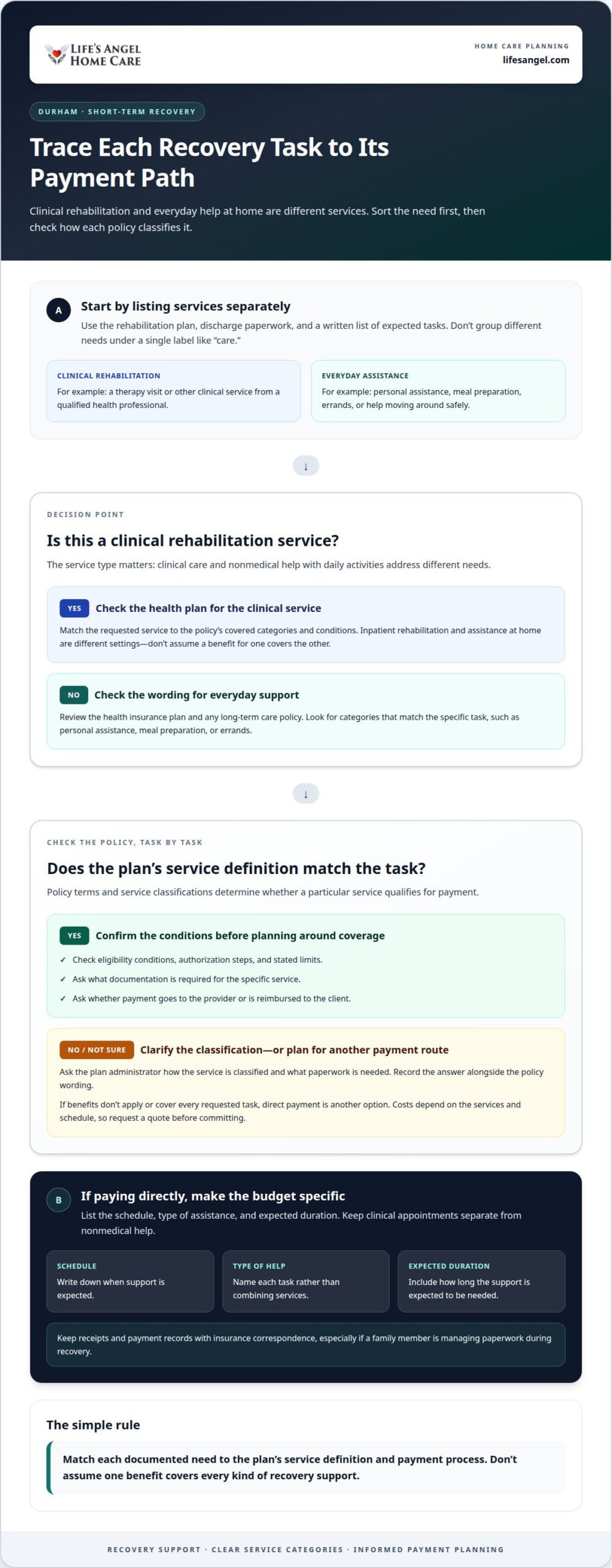
Start by separating the services involved in recovery. Benefits for rehabilitation and assistance with everyday activities may be assessed differently, even when both help someone after an illness. A policy’s terms and service classifications determine whether a particular service qualifies for payment. Inpatient rehabilitation and assistance at home, for example, are different settings, so don’t assume one benefit covers both.
Review the health insurance plan and any long-term care policy your loved one holds. Look for covered service categories, eligibility conditions, authorization steps, and stated limits. Then match each need to the relevant description, such as a therapy visit, personal assistance, or help with errands. This can clarify which questions relate to clinical rehabilitation and which concern daily support at home.
Before discharge, gather the rehabilitation plan, discharge paperwork, and a written list of expected tasks. Ask the plan administrator how each service is classified, what documentation is required, and whether payment goes to the provider or is reimbursed to the client. Record the answers alongside the policy wording. If your loved one needs meal preparation as well as therapy appointments, list those separately rather than grouping both under “care.”
Direct payment is another option when insurance benefits don’t apply or cover every requested task. Build a simple care budget by listing the schedule, type of assistance, and expected duration, then separate clinical appointments from nonmedical help. Costs depend on the services and schedule, so request a quote before committing. Keep receipts and payment records with insurance correspondence, especially if a family member is managing paperwork during recovery.
These steps help clarify which payment options to explore without assuming a policy covers a particular service. For short-term recovery care at home in Durham, compare your loved one’s documented needs with each plan’s service definitions and payment process.
Accreditation and state certification
Accreditation and state certification describe different kinds of recognition. Accreditation generally refers to an outside organization’s review of a provider’s policies and practices. State certification relates to requirements that may apply to a particular provider or service category. When arranging recovery support in North Carolina, consider the service involved before interpreting either credential.
What qualifications and services should I look for in a recovery caregiver? Match qualifications to the work: clinical services require appropriate health professionals, while nonmedical support focuses on daily tasks and safe assistance. Ask how the caregiver’s role supports the transition home and whether the requested service fits that role.
A useful first step is to distinguish clinical needs from practical support. A therapist’s exercise plan, for example, is different from help moving safely around the home. Ask what training applies to each task, who oversees clinical decisions, and how concerns are shared with the appropriate care professional. Clear role boundaries help your family understand what the support includes.
Accreditation can provide information about an organization’s review process, but it doesn’t replace understanding the services provided. Read the credential’s scope and issuing organization, then compare them with the support you’re considering. A credential focused on one service may not describe every part of a recovery plan.
State requirements can depend on the type of service. In North Carolina, distinguish agency-level recognition from an individual caregiver’s qualifications, and consider whether the planned work is clinical or nonmedical. Don’t treat a general certificate as proof that someone is qualified for every task. Assistance with daily routines and clinical treatment, for example, involve different responsibilities.
Also consider communication and emotional wellbeing. Recovery can bring stress or mental health concerns alongside physical needs, so identify who should receive concerns and how those concerns reach the care team. A focused plan can name the responsible contact, outline the caregiver’s role, and explain how support fits the person’s routine. This helps put credentials in context.
Personal care and mobility assistance at home
Leaving a hospital or rehabilitation facility can reveal which daily routines need more support. A personalized plan starts with specific tasks, such as getting dressed, moving between rooms, or running an errand. Practical help can make the transition home more manageable while your loved one continues the treatment plan set by their clinical team.
Are respite care, transportation, meal help, and overnight care available in Durham? These are distinct needs, and families shouldn’t assume one type of support includes them all. Life’s Angel Home Care provides personal care, mobility assistance, errands, meal preparation, light housekeeping, companionship, and accompanied appointments. This is nonmedical in-home support, not clinical care or overnight coverage.
For mobility, start with movements the person’s therapist has already discussed. Note whether they need help standing, walking to the bathroom, or reaching a chair. Keep rugs, shoes, and bath mats out of walkways, and place commonly used items within comfortable reach. A helper’s presence doesn’t mean your loved one should attempt a transfer they haven’t been instructed to do.
Personal care can be adapted to preserve dignity and energy. A caregiver can assist with everyday routines at the person’s pace, allowing time to rest between tasks. If preparing food takes effort, setting up items while seated may help conserve energy. Errand assistance can take care of practical needs outside the home, so the recovering person doesn’t have to manage every task alone.
Write down the hardest parts of the day, such as dressing in the morning or moving safely to the kitchen. That short list gives family members a clear starting point for arranging support. As recovery changes, update it to reflect what the person can do comfortably and where help remains useful. For compassionate support with personal routines, mobility, or errands, contact Life’s Angel Home Care.
Life’s Angel Home Care
Life’s Angel Home Care helps make the transition from rehabilitation to home easier when everyday tasks are still challenging. Personal Care, Mobility Assistance, Errand Assistance, and Light Housekeeping can support familiar routines while your loved one follows their clinical team’s recovery plan.
In-home support can help when dressing, moving around the house, keeping up with errands, or managing light household tasks takes more energy than expected. It complements rehabilitation but doesn’t replace clinical treatment. Identify the tasks that feel hardest and decide which practical help would bring your family the most comfort.
As your loved one’s needs change, the support plan can focus on the daily activities where assistance is useful. For a kind conversation about support at home, contact Life’s Angel Home Care.
Make the Next Step Feel Manageable
As you plan short-term recovery care at home in Durham, choose a practical next step: write down the daily activities your loved one wants to manage more comfortably. This gives your family a shared starting point and keeps support focused on what matters, rather than trying to change every routine at once.
Life’s Angel Home Care supports everyday needs through Personal Care, Mobility Assistance, and Errand Assistance. This practical help can ease the demands of returning home while your loved one follows the clinical plan set by their health professionals. Start by noting which activities feel difficult and what assistance would make the day more manageable.
Care needs can shift as strength and confidence return, so keep the conversation open with your family and care team. A small, thoughtful plan can help everyone approach the next stage with greater clarity and care. For a supportive conversation about home assistance, contact Life’s Angel Home Care. Your family can take recovery one step at a time.
Frequently Asked Questions
What happens when someone needs more help after returning home than expected?
Update the support plan as tasks become difficult, such as getting dressed, preparing a simple meal, or moving between rooms. Share changes with your loved one’s care team, especially if their health or symptoms have changed. For short-term recovery care at home in Durham, separating daily assistance from clinical concerns helps your family plan appropriate support.
What is short-term recovery care at home in Durham, NC?
Short-term recovery care at home helps someone manage everyday life while recovering from surgery, illness, or rehabilitation. Depending on the person’s needs, assistance may include personal routines, mobility, meals, or errands. This support differs from clinical treatment such as therapy or skilled medical care. Start by identifying which daily activities are difficult after returning home.
What types of post-surgery and short-term home care are available in Durham?
Home support can include personal care, mobility assistance, meal preparation, light housekeeping, companionship, errands, and accompanied appointments. The right mix depends on the person’s routine and which tasks are challenging. Someone who can prepare food but struggles to carry groceries, for example, may need a different arrangement from someone who needs help dressing or moving around the home.
How much does short-term in-home recovery care cost in Durham, NC?
The cost depends on the requested schedule and tasks, and is provided after a quote request. The amount of assistance, timing, and duration shape the quote. To describe your needs clearly, list the activities that require help and when they occur, such as morning personal routines or errands during the week. This gives the quote request useful context.
Does Medicare, Medicaid, or insurance cover short-term home care after surgery in North Carolina?
Coverage depends on the plan, service type, and eligibility criteria, so don’t assume every form of home assistance is covered after surgery. Plans may treat clinical services differently from help with daily activities. Review the relevant benefit terms and ask the insurer whether the specific service requires documentation or authorization, and what out-of-pocket costs may apply.
How can I find and compare licensed home care agencies in Durham, NC?
Start by distinguishing an agency’s state authorization from individual staff credentials, as they describe different things. Then match the stated scope of care to the tasks needed, such as help with personal routines or mobility. For clinical services, identify the qualified health professional responsible. A written description of duties and boundaries can make it easier to understand what the arrangement covers.