

A routine walk from the bedroom to the bathroom can feel less simple when a loose rug, dim hallway, or unsteady transfer gets in the way. It’s understandable to worry that an ordinary household obstacle could lead to a fall and to wonder which changes may help without taking away independence. Thoughtful fall prevention mobility support at home starts with the person’s daily routines, not a one-size-fits-all checklist.
This guide offers a room-by-room way to spot manageable hazards, prioritize practical changes, and consider mobility support that fits your loved one’s needs. You’ll also learn when balance concerns, a new or recurring fall, or uncertainty about a walking aid are reasons to seek clinical advice. Some adjustments may be simple to make, while equipment choices and home modifications may call for professional assessment.
We’ll look at common trouble spots throughout the home, ways to support everyday movement, and how respectful in-home assistance may help when family support isn’t enough. Whether you’re caring for someone in Durham, Chapel Hill, or Raleigh, small, well-matched steps can help protect comfort and dignity while making daily life feel more manageable.
Key Takeaways
- Use a room-by-room checklist to spot everyday hazards around entrances, hallways, living areas, bathrooms, and bedrooms.
- Compare home changes, mobility aids, and hands-on help to understand what each may address and who can advise you.
- Start fall prevention mobility support at home by discussing priorities, observing routines, and choosing manageable first steps.
- Keep notes on stumbles, near-falls, and changes in balance or confidence to share with a healthcare professional.
- Consider respectful in-home mobility assistance when family help is limited, while keeping clinical guidance part of the plan.
Fall Prevention Mobility Support at Home: Start With Daily Routines
A stumble, near-fall, or sudden reluctance to walk across the room can unsettle the whole family. It’s natural to want to make things safer right away, while also wondering how to help without making a loved one feel watched or restricted. Start by noticing what has changed during familiar routines. Specific observations can help guide thoughtful next steps.
Fall prevention is a layered effort to reduce risks, not a promise that every fall can be prevented. It may involve adjusting the environment, reviewing daily routines, getting professional advice about mobility equipment, and arranging another person’s assistance when needed. These approaches work best when they fit the individual and the activities that matter to them. For a broader overview of comprehensive fall prevention strategies, consider how different factors can contribute to fall risk.
Which changes in everyday movement deserve attention?
Notice whether standing from a chair, turning toward a doorway, reaching for a cupboard, or walking between commonly used rooms seems harder than before. You might also hear that someone feels unsteady or see them avoid a shower, meal, or favorite activity they previously managed. Record what you notice and when it happens. Describe the movement plainly rather than guessing at a cause or labeling the person as unsafe.
New or recurring falls deserve a conversation with a healthcare professional. Share when a fall or near-fall occurred, what the person was doing, and any changes in confidence or movement you’ve noticed. A clinician can help assess possible causes and advise whether further evaluation or support may be appropriate.
How can families discuss safety without taking away independence?
Begin with the older adult’s priorities. Ask which routines feel difficult, what they want to keep doing, and what kind of help would feel comfortable. Offer choices to make the conversation collaborative: would they rather try a different route through the home, move an often-used item within easier reach, or discuss a mobility aid with a clinician? Agree on one manageable adjustment at a time, then check whether it feels useful.
Respectful fall prevention mobility support at home should consider a person’s preferences as well as their movement. A family discussion can include what kind of help feels welcome, from practical changes to assistance with everyday mobility. For more guidance on weighing options together, see this senior mobility family buying guide. The aim isn’t to take over, but to find a comfortable next step that makes daily life more manageable.
A Room-by-Room Fall Prevention Checklist for the Home
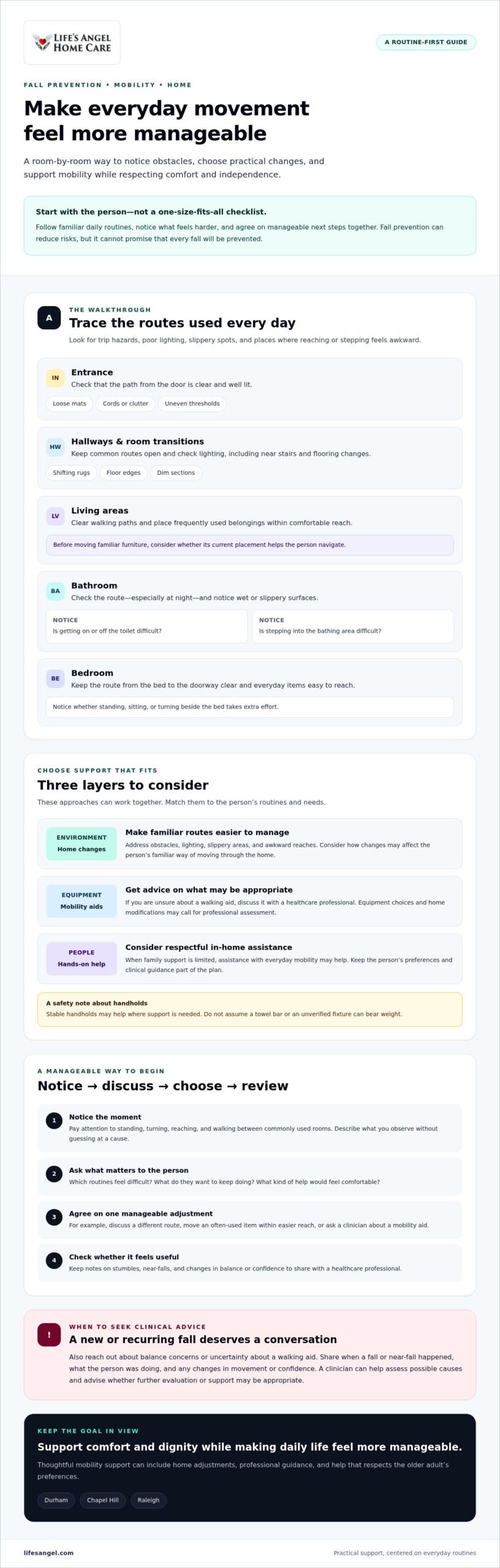
A calm walkthrough can make safety concerns easier to sort through. Follow the routes your family member uses each day, and look for obstacles, poor lighting, slippery spots, and places where reaching or stepping feels awkward. The goal is to make familiar routines easier to manage, not to rearrange the home without considering how the person moves through it.
Check the entrance, hallways, and living areas
- Entrance: Check that the path from the door is clear and well lit. Look for loose mats, cords, clutter, and uneven thresholds that may catch a foot or make a step harder to see.
- Hallways and room transitions: Keep commonly used routes open, and check lighting along the way, including at stairs and changes in flooring. Notice whether rugs shift or floor edges create a trip point.
- Living areas: Move frequently used belongings within comfortable reach, and keep walking paths clear of furniture, footstools, and cords. Before moving familiar furniture, consider whether the person relies on its current placement to navigate.
What should families check in bathrooms and bedrooms?
- Bathroom: Check whether the route to the bathroom is lit and clear, especially at night. Look for wet or slippery surfaces and consider whether getting on and off the toilet or stepping into the bathing area seems difficult.
- Bedroom: Notice whether standing up, sitting down, or turning beside the bed takes extra effort. Keep the route from the bed to the doorway clear, and place everyday items where they can be reached without stretching or climbing.
Stable handholds may help in places where someone needs support, but a towel bar or an unverified fixture shouldn’t be treated as weight-bearing. Grab bars and other fixed supports need suitable placement and secure installation. Ask a qualified professional to assess the location and installation rather than relying on a quick visual check.
Use this checklist to identify questions, not to choose equipment or diagnose a mobility concern. If a change in movement or confidence is troubling, share what you’ve noticed with a healthcare professional. The CDC’s STEADI initiative is another resource families can review as they prepare for a fall-prevention conversation. Together, these steps can turn fall prevention mobility support at home into a practical plan shaped around daily life. If help with everyday mobility may be useful, you can learn about in-home mobility assistance as one possible part of that plan.
Compare Mobility Support Options: Home Changes, Aids, or Hands-On Help
There isn’t one right answer for every household. A clearer walkway, a properly chosen mobility aid, and help from another person address different needs, and they may be used together. This comparison can help families decide what to explore first while keeping the older adult’s routines and preferences central to fall prevention mobility support at home.
| Option | Purpose | Who can advise | Limitation to consider |
|---|---|---|---|
| Environmental changes | Reduce obstacles or make frequently used routes easier to navigate. | An occupational therapist or other appropriate professional can advise on individual needs; a qualified installer should handle fixed supports. | A change that helps one person may not suit another, and modifications alone don’t address every mobility concern. |
| Mobility aids | Provide support during walking or other movement, when appropriate. | A physical or occupational therapist, or another healthcare professional, can assess needs and offer selection or fitting guidance. | An aid that doesn’t fit the person, home, or task may be difficult to use safely. |
| Person-to-person assistance | Offer attentive help with everyday movement and routines. | A healthcare professional can advise on mobility needs; a home-care provider can discuss whether its assistance fits the family’s situation. | Support must match the person’s needs and the caregiver’s training. It isn’t a substitute for clinical assessment or emergency response. |
When might a cane, walker, or other mobility aid need review?
Consider asking for guidance if an aid feels awkward, is difficult to maneuver at home, or no longer seems to match the person’s usual activities. A physical or occupational therapist, or another appropriate healthcare professional, can assess the person’s mobility and offer advice about fit and use. There’s no single aid that suits everyone, so avoid borrowing or choosing equipment based only on someone else’s experience. The National Institute on Aging also offers fall prevention tips for seniors, including guidance on discussing prevention with a healthcare provider.
What can a home caregiver help with during daily movement?
Hands-on help can make familiar routines feel more manageable when family members aren’t always available. A home caregiver may provide mobility assistance, but the right approach depends on the person’s needs and the caregiver’s training. Ask the provider what assistance is appropriate. Transfers shouldn’t be attempted in a way that exceeds either person’s abilities. For more context, read this step-by-step guide to safe home mobility transfers.
Asking for help doesn’t have to mean giving up independence. Thoughtful support can help someone keep participating in daily routines while receiving assistance where it’s welcome.
Put the Fall Prevention Checklist Into Action, One Step at a Time
A home walkthrough can bring up a lot of concerns at once. You don’t have to address everything in one day. A shared, written plan helps your family sort immediate concerns from changes that need more advice, while keeping the older adult involved in decisions.
- Discuss priorities. Ask which daily activities feel most important and where the person feels less steady or comfortable. Agree on one focus, such as getting from the bedroom to the bathroom.
- Walk through familiar routines. Observe the routes the person actually uses, including how they get up, turn, reach for items, and move between rooms. Avoid rushing or asking them to demonstrate anything that feels unsafe.
- Write down concerns. Note where a hazard occurs, what was happening, and whether the concern is new or recurring. Include falls, near-falls, or changes in confidence, and share relevant observations with a healthcare professional.
- Choose the first steps together. Clear an obstruction from an essential route or move a frequently used item within reach if the adjustment feels comfortable. Record who will arrange follow-up, such as asking a clinician about mobility or arranging professional installation of a fixed support.
Simple household adjustments may be manageable for the family, but choosing equipment, assessing mobility, and installing grab bars or other fixed supports can require professional advice or a qualified installer. A checklist can guide conversations, but no single change can prevent every fall. Revisit the plan after a change in health, mobility, or home layout, and check whether each adjustment still works for the person.
When should a family seek clinical or urgent help?
Talk with a healthcare professional about repeated falls, new balance concerns, or a sudden change in walking. Share your notes rather than trying to determine the cause on your own. If there’s a serious injury or immediate danger, contact local emergency services. Routine home-care or mobility assistance may help with everyday needs, but it isn’t a substitute for medical assessment or emergency care.
These small, agreed-upon steps can make fall prevention mobility support at home feel more manageable while respecting the older adult’s choices. If your family would like to discuss whether in-home mobility assistance may fit your needs, contact Life’s Angel Home Care.
When In-Home Mobility Support Can Help Older Adults Stay Comfortable
Family members often want to be there for every walk, transfer, and daily task, but work, distance, and other responsibilities can make that difficult. In-home mobility assistance may offer another source of person-to-person help with everyday routines. It can complement practical home changes and healthcare guidance, while allowing an older adult to stay involved in decisions about the support they welcome.
Life’s Angel Home Care provides in-home mobility assistance and personal care for seniors and adults with disabilities. Its care team includes board-certified registered nurses, nursing assistants, and care aides. The agency’s nursing assistants and care aides are BLS and CPR/AED certified. This describes the team, not a promise of clinical treatment or fall prevention. Caregivers don’t diagnose mobility concerns, prescribe aids, or replace a healthcare professional’s assessment. Routine home-care assistance also isn’t emergency response or 24/7 live-in skilled nursing care.
What should families discuss when exploring in-home mobility assistance?
Begin with the older adult’s own perspective. Share which routines matter most, what movement feels challenging, and what kind of help feels comfortable. Describe the home layout and the routes used most often, such as getting from a bedroom to a meal or moving around the living area. Be specific about preferences, including when the person wants assistance and when they’d rather manage independently.
Ask how a caregiver can work respectfully with family preferences and any relevant guidance from healthcare professionals. If a clinician has recommended a particular approach or mobility aid, clarify how that guidance fits within the provider’s scope of assistance. You can also read about personal care services for safe daily living at home as you consider what everyday support may look like.
How can a care conversation make next steps feel manageable?
A first conversation can help clarify whether the assistance a family is considering matches the services available. Ask about scheduling, caregiver qualifications, and the scope of mobility assistance. For families in Durham, Chapel Hill, or Raleigh, confirm current service coverage for your location before making plans. Share any tasks that may require clinical advice or specialized support. It’s reasonable to take time to compare options and decide together.
Asking for help can support independence when it gives someone a respectful choice about managing daily routines, rather than taking decisions out of their hands. If you’d like to talk through your family’s needs and ask about available mobility assistance, talk with Life’s Angel Home Care about mobility support. A thoughtful conversation can be a gentle first step toward finding support that feels right for your loved one.
Take the Next Step Toward More Comfortable Daily Routines
A safer home plan doesn’t need to happen all at once. Start by noticing which everyday routes or movements feel difficult, then use the room-by-room checklist to prioritize practical changes. Clearing paths and improving lighting may be straightforward adjustments, while mobility aids or fixed supports can call for advice from an appropriate healthcare professional or qualified installer.
Remember, fall prevention mobility support at home is about reducing risks in ways that respect the older adult’s routines and choices, not promising that falls can be eliminated. Document changes in balance, confidence, or walking, and share concerns about new or recurring falls with a healthcare professional. When family help is limited, hands-on mobility assistance may be another option to discuss.
In-home mobility assistance is among Life’s Angel Home Care’s listed services. The team includes board-certified registered nurses, nursing assistants, and care aides certified in BLS and CPR/AED. To discuss your family’s needs and ask about available support in Durham, Chapel Hill, or Raleigh, contact Life’s Angel Home Care.
Frequently Asked Questions
How can I make my home safer for an older adult at risk of falling?
Start by clearing everyday walking routes and improving lighting where the person walks, especially between the bedroom and bathroom. Check for loose rugs, electrical cords, clutter, slippery surfaces, and uneven floor transitions. Keep frequently used items within easy reach, and review how the person gets in and out of bed or uses the toilet. Fixed supports such as grab bars should be assessed and installed by qualified professionals.
Can a caregiver help prevent falls at home?
A caregiver may offer attentive help with everyday mobility and routines, but can’t guarantee that falls will be prevented or replace clinical assessment. Depending on the person’s needs and the caregiver’s training, assistance may make familiar activities feel more manageable. For families in Durham, Chapel Hill, or Raleigh, Life’s Angel Home Care lists mobility assistance among its services. Ask about the scope of support and confirm current coverage for your location.
What should I do if my older parent has started falling at home?
Contact a healthcare professional about new or repeated falls, changes in balance, or a sudden change in walking. Share when each incident happened, what your parent was doing, and any changes in confidence or daily activity. If there’s a serious injury or immediate danger, contact emergency services. Keep notes and review the home for hazards, but don’t assume that a household change alone addresses the reason for a fall.
Does a cane or walker reduce the risk of falling?
A cane or walker may support mobility when it’s appropriate for the person, but the right choice and fit depend on individual needs, the home environment, and daily activities. Ask a physical or occupational therapist or another healthcare professional for assessment and guidance. Avoid choosing an aid based only on a relative’s experience or buying one without considering how it will be used. An aid isn’t a substitute for addressing other fall risks.
Are grab bars enough to prevent bathroom falls?
No single support can address every bathroom fall risk. Grab bars may provide a stable handhold when properly selected, placed, and installed, but families should also consider lighting, slippery surfaces, and the person’s comfort getting on and off the toilet or entering the bathing area. Don’t use towel bars or unverified fixtures to bear weight. Ask a qualified professional about fixed supports, and consult a healthcare professional about individual mobility concerns.
When should a family consider in-home mobility assistance?
Consider asking about in-home mobility assistance when a loved one would welcome help with everyday movement or routines and family support is limited. Discuss which activities feel difficult, what assistance the person prefers, and any relevant guidance from healthcare professionals. Life’s Angel Home Care provides mobility assistance and personal care, with a team that includes board-certified registered nurses, nursing assistants, and care aides certified in BLS and CPR/AED. Confirm service coverage for your location before making plans.