

What if a little help with everyday movement could support your loved one’s independence rather than take it away? If you worry that standing, walking, or getting around the home alone could lead to a fall, it’s understandable to want support that feels safe and respectful. Finding mobility assistance for seniors durham nc families can rely on starts with understanding what help is needed and how your loved one prefers to receive it.
Caregiver assistance and skilled therapy serve different purposes. An in-home caregiver may help with everyday movement and routines while honoring the person’s choices and pace. A caregiver does not replace a clinician’s evaluation or prescribed therapy.
This guide explains what mobility help may include, what to ask when comparing providers in Durham, Chapel Hill, and Raleigh, and how to prepare for in-home support. It also covers how appointment accompaniment may fit into daily planning. The aim is to find a practical match for your loved one’s abilities and routines, with dignity at the center.
Key Takeaways
- Explore how mobility assistance for seniors durham nc can be shaped around everyday movement, personal preferences, and familiar routines.
- Discuss what to expect from an in-home visit, including how mobility support may fit alongside other daily needs.
- Compare providers by asking about care-plan fit, staff roles and credentials, communication, scheduling, and service boundaries.
- Prepare by sharing your loved one’s goals and routines, and describing movement challenges without attempting unsafe tests or transfers.
- Involve your loved one in decisions so support complements family care and respects their independence.
What Mobility Assistance for Seniors in Durham, NC Can Include
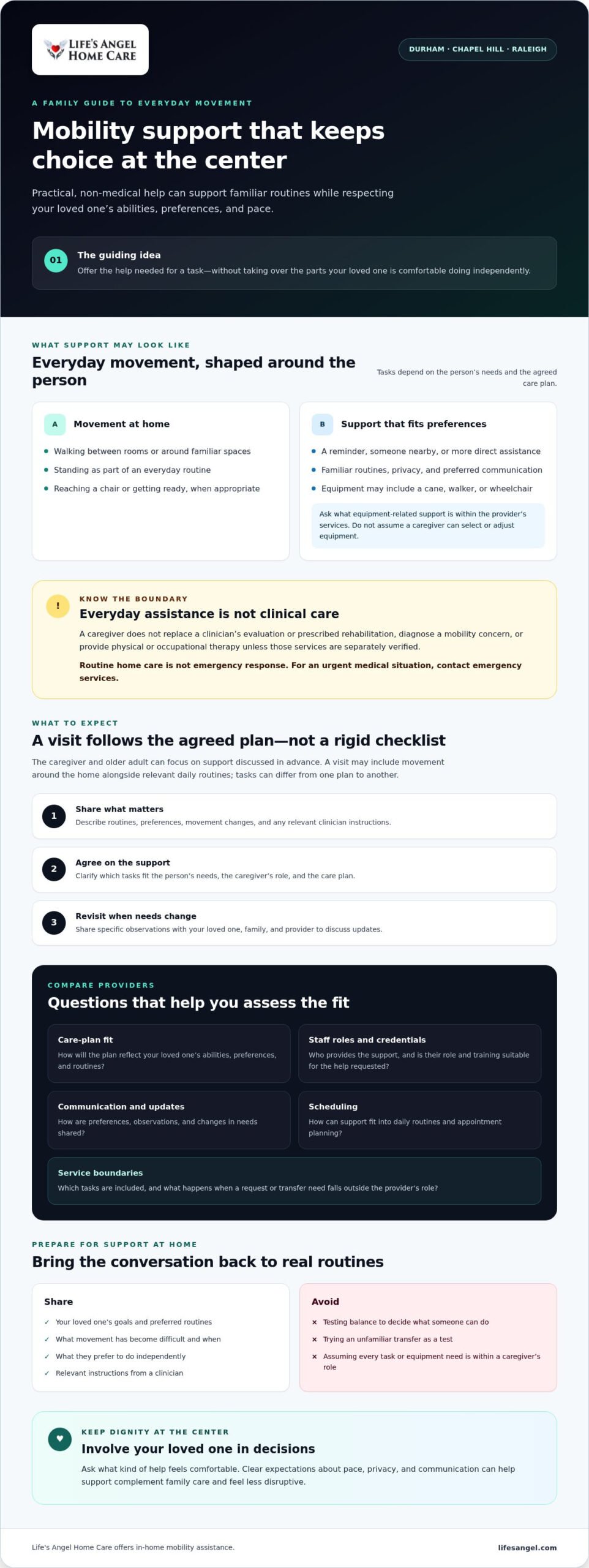
It can be hard to balance concern about a loved one’s safety with their wish to move through the day on their own terms. Mobility assistance for seniors durham nc families explore is practical, non-medical help with everyday movement, shaped around the person’s abilities, preferences, and agreed care plan. The exact tasks should be discussed with the provider: what feels useful for one person may not suit another.
Depending on the plan, support may involve walking around the home, standing, or moving between rooms. This is different from a clinical evaluation or rehabilitation service. A caregiver does not diagnose a mobility concern or provide physical or occupational therapy unless those services are separately verified. Routine home care is not emergency response. For an urgent medical situation, contact emergency services.
Which everyday movements might a caregiver help with?
When appropriate to the person’s needs and the caregiver’s role, help may fit into familiar routines, such as getting ready, reaching a chair, or walking from one room to another. Some older adults use equipment such as a cane, walker, or wheelchair. Mobility aids offers an overview of common types. Don’t assume a caregiver can select or adjust equipment. Ask which kinds of support are within the provider’s services and the agreed plan.
Start by asking your loved one what kind of help feels comfortable. They may prefer a reminder, someone nearby, or more direct assistance. Their answer can guide the plan and help the caregiver understand when to offer support.
How can support protect independence and dignity?
Good support does not mean taking over. It means offering the help needed for a particular task while allowing the older adult to do familiar parts themselves when they are comfortable. Talk about preferred routines, how the caregiver should communicate, and what privacy means to your family. Clear expectations can make accepting help feel more personal and less disruptive.
Needs and comfort levels may change, so revisit the plan with your loved one, family, and provider. Share specific observations, such as a familiar routine becoming harder, and ask how the provider handles updates. Avoid testing someone’s balance or attempting an unfamiliar transfer to judge what they can do. Describe what you have noticed and ask how needs are discussed and matched to appropriate support. A room-by-room approach to fall prevention mobility support at home can help families identify manageable hazards and prioritize practical changes before care begins.
What to Expect from In-Home Mobility Assistance
An in-home visit should reflect the person’s agreed care plan, not a rigid checklist. The caregiver and older adult can focus on the support discussed in advance, which may include help moving around the home alongside relevant daily routines. Not every visit or service includes the same tasks. Families considering mobility assistance for seniors durham nc can ask how the person’s preferences, abilities, and requested support shape the plan.
Everyday assistance supports agreed routines; clinical care evaluates or treats health and mobility needs. A caregiver does not replace a clinician’s assessment or prescribed rehabilitation. If you are unsure whether a movement concern calls for professional evaluation, or whether a request fits a caregiver’s role, check with an appropriate healthcare professional and the provider.
Walking, standing, and moving around the home
When it is included in the care plan and appropriate to the person’s needs, a caregiver may provide agreed-upon support as the person moves through familiar spaces. This could mean walking between rooms or standing as part of an everyday routine. Share mobility changes, the older adult’s preferences, and any relevant clinician instructions with the provider. Ask how those details will guide the support offered.
Transfers, equipment, and changing needs
Discuss transfer needs and any mobility equipment during the initial care conversation rather than assuming a caregiver can provide every type of assistance. Ask whether the caregiver’s role and training are suitable for the specific help requested, and how the provider handles changes in needs. If the right level of support is unclear or movement has changed, seek guidance from an appropriate healthcare professional before revising the plan.
Describe real routines: when movement feels difficult, what the older adult prefers to do independently, and any relevant instructions a clinician has provided. Do not ask a family member or caregiver to try an unfamiliar transfer as a test. Explain what you have observed and ask whether it fits the provider’s scope and care plan. This keeps the conversation practical without treating a home-care visit as a clinical assessment. For a step-by-step overview of how to approach mobility transfer assistance at home safely, including preparation and communication strategies, that guide covers practical principles families can review before care begins.
Life’s Angel Home Care offers in-home mobility assistance. If you’re exploring in-home mobility assistance, ask how the provider discusses requested tasks, staff suitability, and changes in your loved one’s needs.
How to Compare Mobility Assistance Providers in Durham
Choosing a provider is about more than finding someone who can help with movement. Confirm that the requested support fits the agency’s services, the caregiver’s role, and your loved one’s preferences. For families looking into mobility assistance for seniors durham nc, specific questions can clarify expectations before care begins.
| What to compare | Questions to ask |
|---|---|
| Care-plan fit | How do you learn about mobility preferences, routines, and changing needs? |
| Staff credentials | Which staff roles may provide this support, and what training or credentials apply to each? |
| Communication | Who should family members contact with concerns, and how should changes be shared? |
| Scheduling | What schedule can you discuss for the requested assistance? |
| Service boundaries | Which tasks are within your service scope, and when should we consult a healthcare professional? |
Non-medical support may not fit every mobility need. Ask the provider to explain what a caregiver can do under the care plan and what falls outside that role. Caregiver assistance does not replace clinical evaluation or prescribed rehabilitation. If your loved one’s needs are complex or changing, ask when to seek guidance from an appropriate healthcare professional.
Questions to ask about caregiver qualifications and fit
Ask which caregiver roles may provide the requested help and what training applies to each role. Find out how the agency considers your loved one’s routines, communication style, and support needs when matching a caregiver. Verify qualifications directly rather than assuming every staff member has the same credentials. Staff roles and credentials can differ, so ask about the person who may provide the specific assistance you need.
How to understand service scope and coordination
Be specific about the daily mobility tasks you are asking about, and confirm which are included in the agency’s services and care plan. Discuss how family members can report concerns or changes and who will respond. Ask what situations should prompt you to contact a healthcare professional instead of relying on routine caregiver assistance.
Before choosing a provider, ask what help is included, who is qualified to provide it, how preferences and changes are communicated, what scheduling is possible, and when clinical guidance is needed. Clear answers make it easier to compare providers and find a respectful fit.
How to Prepare for Mobility Support at Home
Preparation can help in-home support feel familiar and respectful rather than like a new set of rules. Focus on what your loved one wants help with, what context the provider needs, and how you will revisit the plan if needs change.
Use this sequence to guide the conversation:
- Discuss goals: Ask what your loved one hopes to keep doing and where they would welcome assistance.
- Describe routines: Note familiar activities and times of day when movement feels more difficult or support may be appreciated.
- Share relevant guidance: With your loved one’s consent, pass along clinician instructions that may help the provider understand the requested support.
- Review the plan: Confirm what assistance is agreed upon, how questions or changes will be shared, and when you’ll check in again.
Pay attention to challenges your loved one mentions or that you observe during familiar routines. Don’t ask them to demonstrate a difficult movement, test their balance, or attempt a transfer to see what they can manage. Describe what you have noticed and discuss it with the provider. If a concern is new or unclear, an appropriate healthcare professional can offer guidance.
Share routines and preferences before support begins
Include your loved one’s priorities, not just the family’s concerns. They may welcome help at a particular time or during a familiar activity while preferring privacy or a specific way of being spoken to. Write down communication preferences and goals for staying active. Share relevant clinician instructions with the provider when appropriate and with the older adult’s consent.
Review the home and revisit the plan
Ask which parts of the home your loved one finds difficult to move through, and discuss the layout and any mobility equipment with the caregiver and appropriate professionals. A caregiver can share observations within their role; questions about equipment or home changes may call for qualified professional guidance. Reviewing a fall prevention and mobility checklist for your home can help you spot common hazards room by room before support begins. Agree on how family and care staff can communicate updates, and revisit the arrangement if routines, abilities, or preferences change.
If you’re considering mobility assistance for seniors durham nc, a conversation about your loved one’s routines and goals can help clarify whether in-home support may fit. Discuss in-home mobility assistance with Life’s Angel Home Care and ask what support may be appropriate for your family’s needs.
Choosing Life’s Angel for Mobility Assistance in Durham
Choosing support is personal. You want help that fits your loved one’s everyday needs while respecting their routines, preferences, and independence. Life’s Angel Home Care offers in-home mobility assistance in Durham, along with daily living support and scheduled transportation with personal accompaniment to appointments. Families exploring mobility assistance for seniors durham nc can use the questions in this guide to discuss whether the requested help fits the agency’s services and care plan.
Life’s Angel Home Care employs board-certified registered nurses, nursing assistants, and care aides who are BLS and CPR/AED certified. Ask which staff member may provide the specific assistance your family is considering and what training or credentials apply to that role. Discuss the tasks involved, your loved one’s movement preferences, scheduling, and how the care plan is agreed upon. These questions help clarify the service’s scope without assuming every caregiver has the same qualifications or that non-medical assistance meets every mobility need.
What families can discuss with Life’s Angel Home Care
Describe the movement challenges your loved one experiences during familiar routines, what help they would welcome, and what they prefer to continue doing independently. Share relevant clinician guidance when appropriate and with your loved one’s consent. Ask how the agency learns about preferences and changing needs, how family members can communicate concerns, and when a healthcare professional should be consulted. For related daily living support, see this guide to personal care services in Durham.
If you’re also considering appointment accompaniment, ask how that service may fit alongside in-home support and what arrangements are available for your family. Confirm the details directly rather than assuming a particular schedule or service is available.
A gentle next step for Durham-area families
An initial conversation can help you explain what your family is looking for and learn whether the requested support fits the agency’s services. Your loved one can share their preferences directly, or a family decision-maker can bring questions on their behalf. You do not need to have every detail settled first. Starting with the everyday routines that feel difficult can make the discussion more useful.
For a next step, talk with Life’s Angel Home Care about mobility assistance. Ask about service scope, caregiver roles, scheduling, and what to expect as you consider support that respects your loved one’s choices.
Find Support That Respects Your Loved One’s Routine
The right mobility support starts with listening. Your loved one’s abilities, preferences, and daily habits can shape practical assistance that feels respectful rather than like someone taking over. As you compare options for mobility assistance for seniors durham nc, ask providers to clarify what everyday help includes, which caregiver roles are appropriate, and how changing needs will be discussed.
Life’s Angel Home Care is a Durham-based in-home care agency serving seniors and adults with disabilities. Its services include mobility assistance and scheduled appointment transportation with personal accompaniment. The agency employs registered nurses, nursing assistants, and care aides. Ask which qualifications apply to the staff role being considered, since credentials may differ.
A conversation can help you understand the service scope, discuss scheduling, and share your family’s questions. Talk with Life’s Angel Home Care about mobility assistance and explore whether its in-home support may fit your loved one’s needs. With clear expectations and your loved one’s voice at the center, you can take the next step with greater confidence.
Frequently Asked Questions
What does mobility assistance for seniors at home include?
At-home mobility assistance can involve agreed-upon help with everyday movement and routines, based on the person’s needs and the provider’s service scope. A caregiver may assist with walking through familiar areas or standing as part of a daily activity if that support is appropriate and included in the care plan. Discuss requested tasks in advance. Caregiver assistance supports daily routines, but it does not replace a clinical assessment or prescribed therapy.
Can an in-home caregiver help a senior walk safely?
A caregiver may provide agreed-upon help with walking when the task fits their role, training, and the person’s care plan. No provider can promise that assistance will prevent a fall or make walking risk-free. Describe your loved one’s needs and preferences, and ask whether the requested support is within scope. If walking ability has changed or you are unsure what help is appropriate, seek guidance from a healthcare professional.
How do I know whether my parent needs mobility assistance at home?
Notice recurring difficulty with everyday movement, a growing need for another person’s help, or concerns your parent shares about getting around at home. These observations do not diagnose a health problem, but they can guide a caring conversation. Ask what feels difficult and what help they would welcome. If the change concerns you or your parent, contact an appropriate healthcare professional, then ask a home-care provider which support falls within its services.
Is mobility assistance the same as physical therapy?
No. Mobility assistance from an in-home caregiver involves agreed-upon help with daily routines, while physical therapy involves assessment and treatment by an appropriately qualified professional. Do not assume a caregiver can diagnose a mobility concern or provide rehabilitation. If you’re considering therapy, ask a healthcare professional what’s appropriate. When speaking with a home-care provider, confirm which everyday mobility tasks are within its scope and what qualifications apply to the caregiver’s role.
What should I ask a mobility assistance provider in Durham, NC?
Ask which daily tasks the provider supports, which caregiver roles may assist, and what training or credentials apply to each role. Find out how your loved one’s routines and preferences shape the care plan, and how family members can report changes. Confirm current service-area coverage in Durham, Chapel Hill, or Raleigh, as relevant, along with scheduling and service boundaries. Ask what happens if a requested task falls outside the provider’s scope.
Can a caregiver take my senior loved one to appointments?
Life’s Angel Home Care offers scheduled transportation and personal accompaniment to appointments. Ask the agency to confirm current availability, trip arrangements, and whether the level of assistance your loved one needs is included. Appointment accompaniment is not emergency ambulance transportation. If your loved one needs emergency help, contact emergency services rather than relying on a scheduled in-home care or appointment service.
How can mobility assistance help a senior remain independent at home?
Respectful, agreed-upon assistance can let an older adult take part in familiar routines while receiving only the help they want or need. Independence can look different from person to person, so include your loved one in decisions about support, privacy, and communication. Discuss their goals with family and the care provider, and revisit the plan as needs or preferences change. For health-related questions, consult an appropriate healthcare professional.