

What if helping your parent stay home safely doesn’t mean doing everything yourself? If you’re wondering how to keep elderly parent at home, it can be hard to tell whether a missed meal, a difficult trip to the bathroom, or a growing list of errands is an everyday challenge or a safety concern. You may also be balancing care with work, family, and your own wellbeing while making sure your parent feels heard and respected.
A manageable plan starts with a clear look at what your parent can do comfortably, where they need help, and what could make daily life at home safer. You’ll learn how to assess changing needs, make practical adjustments, share responsibilities with family, and discuss support in a way that respects your parent’s dignity.
We’ll also look at signs that family help may need to include in-home support, such as assistance with personal care, mobility, meals, errands, companionship, or appointments. With preparation and the right support, staying at home can feel more sustainable for your parent and the people who care about them.
Key Takeaways
- To understand how to keep elderly parent at home, notice patterns in daily routines over several days instead of judging from one difficult moment.
- Look for practical home-safety improvements, such as clear walking paths, better lighting, and everyday items within easy reach.
- Match support to specific tasks and routines, while involving your parent in decisions so help can strengthen independence.
- Build a simple care plan with shared responsibilities, a backup arrangement, and a date to review what’s working.
- Recognize when needs are changing and consider added help with mobility, meals, companionship, or appointments.
How to keep an elderly parent at home: start with what daily life is really like
Balancing your parent’s independence with concerns about safety can be difficult. You may want to respect familiar routines while wondering whether missed meals, difficulty getting around, or less contact with others signals a need for more help. Before making a major decision, take time to understand what daily life actually looks like. A steady, practical review can help you consider how to keep elderly parent at home without letting one frightening or difficult moment define the whole picture.
Over several days, notice which activities your parent manages comfortably, which feel tiring, and what kind of help makes a difference. Separate preferences from support needs: your parent may want to prepare breakfast independently but appreciate help carrying groceries or getting to an appointment. Aging in place can involve adapting support and surroundings so someone can remain in a familiar home, rather than expecting them to manage every task alone.
Use this short checklist to guide your observations:
- Meals: Are meals and drinks part of the usual routine, or are they often missed?
- Getting around: Is moving between rooms or completing familiar tasks becoming harder?
- Errands: Can your parent get essentials and attend appointments in a way that feels manageable?
- Connection: Are they keeping up with the social contact they value, or becoming more isolated?
Which changes may mean your parent needs more support?
Look for repeated difficulty with familiar routines, not just an unusual off day. Write down what happened, when it occurred, and what seemed to help. For example, note whether your parent regularly skips lunch when alone or feels more confident when someone accompanies them on an errand. Share concerns about changes in health or memory with your parent’s healthcare professional. A change is a reason to pay attention, not an automatic decision about where your parent should live.
How to begin a respectful conversation about staying home
Start with what matters to your parent. Ask, “What do you most want to keep doing at home?” or “Which parts of your day have become harder?” Describe specific observations without assigning labels or making ultimatums. You might say, “I noticed the grocery bags were difficult to carry. What would make that easier?” Agree on one manageable change to try, then check in together about how it feels. That keeps your parent involved and gives your family room to adjust the plan.
Make the home and everyday routines safer without taking away independence
A safer home doesn’t need to feel unfamiliar or restrictive. Useful changes often make ordinary routines easier while letting your parent remain in charge of how they move through the day. Walk through the home together as your parent goes about familiar activities, rather than treating safety as a list of rules imposed on them.
Start with the routes and rooms they use most: the entrance, hallways, bathroom, kitchen, and main living area. Notice dim lighting, crowded walkways, or frequently used belongings that require awkward reaching. Ask what your parent finds inconvenient and which adjustment would feel helpful. The National Institute on Aging’s guide to planning for aging in place also discusses home safety and support as part of preparing to remain at home.
What to review in the rooms your parent uses most
Look for practical ways to make movement and everyday tasks more comfortable. Clear walking paths, improve lighting in darker areas, and keep commonly used items within easy reach. Check whether chairs used for resting are stable and easy for your parent to sit down on and rise from. If you notice a change in balance, pain, or difficulty walking, discuss it with an appropriate healthcare professional before changing mobility equipment or routines.
- Entrances and hallways: Check for clutter or items that narrow a familiar path.
- Bathroom and kitchen: Notice whether lighting, storage, or reaching makes routine tasks harder.
- Living areas: Look at the route between a favorite chair, needed belongings, and other frequently used spaces.
For more focused ideas about moving around safely, explore this senior mobility guide.
How to make safer routines feel familiar
Small, consistent habits can support confidence without turning the day into a schedule your parent didn’t choose. Keep everyday belongings in agreed-upon places, and build meals, drinks, activity, and family check-ins around preferences they already have. For example, place a frequently used item where your parent can reach it comfortably, rather than moving it to a new spot without discussion.
Revisit the arrangement if your parent’s mobility, health, or confidence changes. A setup that works now may need adjusting later, and your parent’s input can help each change feel respectful rather than disruptive. If an extra pair of hands would make familiar routines easier, in-home personal support can include mobility assistance, meal preparation, and help with everyday activities.
Match family help, professional support, and your parent’s preferences
Accepting help doesn’t automatically mean giving up independence. The right support can make it easier for your parent to keep familiar routines, make everyday choices, and stay connected to family. A practical answer to how to keep elderly parent at home is often a combination of support, rather than expecting one person to cover every need.
Consider each task, how often it comes up, and who is comfortable helping. A nearby relative might handle a regular grocery trip, while another family member checks in by phone. Community connections can support social routines, and scheduled in-home assistance can cover specific needs at agreed times. The aim is to build a dependable mix that fits your parent’s preferences and your family’s capacity.
Which everyday tasks can family members share?
List recurring tasks, then match them to each person’s availability, location, and comfort. One person may be happy to help with errands, while another can prepare meals or accompany your parent to appointments. Check-ins can also be shared so one relative isn’t carrying the full responsibility. Keep your parent involved in deciding what help feels welcome, and revisit the arrangement as needs or family schedules change.
- Errands: Coordinate grocery or essential-item trips based on who lives nearby.
- Meals: Share meal preparation or arrange help with regular meals.
- Appointments: Plan who can accompany your parent when they need support getting there.
- Check-ins: Agree on a routine that helps your parent stay connected without making them feel monitored.
When scheduled in-home support may make home life more manageable
Family help may not cover every task or every time support is needed. CNA assistance for an aging parent in Durham can be organized around particular needs, including personal care, getting around, light housekeeping, or companionship. Hourly care or scheduled shifts allow families to plan for the tasks and times that would make the greatest difference.
For example, a caregiver might provide mobility assistance during a planned visit, help prepare a meal, or offer companionship that supports a valued social routine. If loneliness or regular conversation is a concern, explore elderly companion care in Durham. Sharing practical tasks more thoughtfully can leave family visits with more room for conversation and connection, not only caregiving duties.
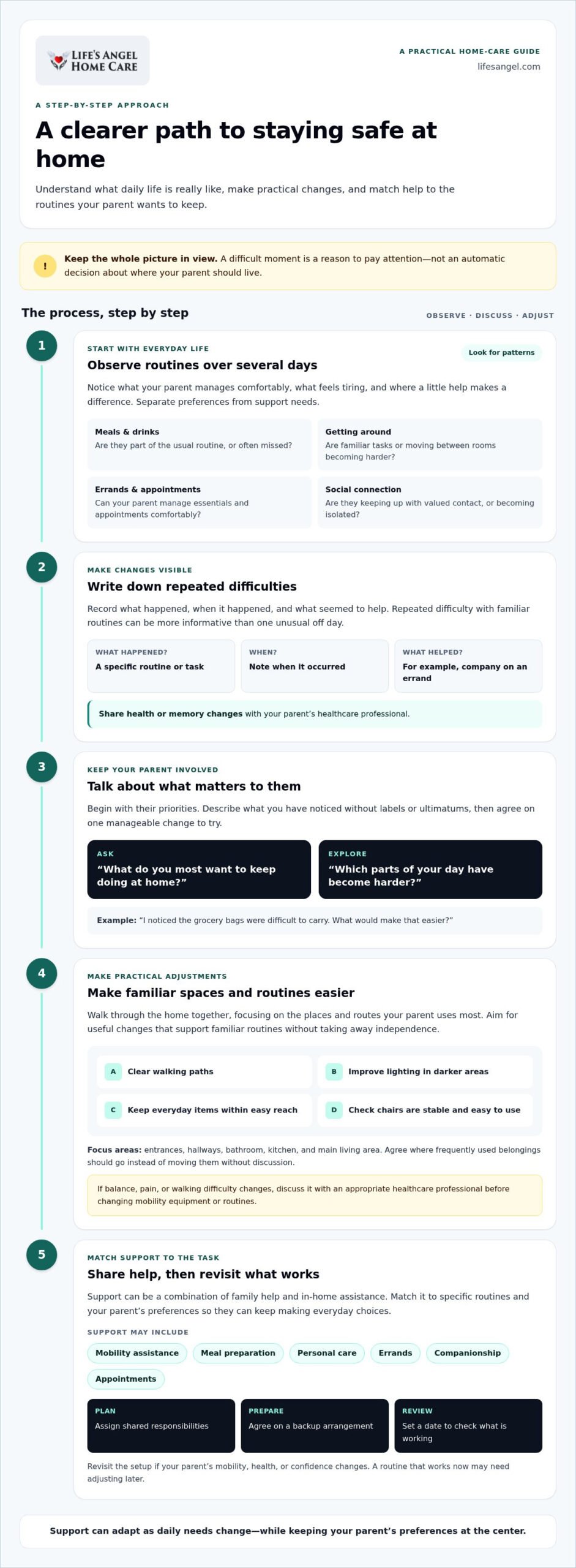
Create a simple care plan your family can follow and review
A written plan can turn good intentions into support everyone understands. It doesn’t need to be complicated. Keep it somewhere your parent can access, invite them to help shape it, and update it as routines or needs change. This shared reference can be especially useful when family members are coordinating from Durham, Chapel Hill, Raleigh, or farther away.
- Record needs and preferences. Note your parent’s usual routine, priorities, key contacts, and the tasks where help is welcome.
- Assign responsibilities. Write down who is handling meals, errands, transportation, companionship, and planned check-ins, along with when they’ll do it.
- Identify a backup. Decide who can step in if someone is ill, a schedule changes, or your parent needs additional support.
- Set a review date. Choose a time to talk together about what’s working and whether any responsibilities or supports need adjusting.
What to include in a useful family support plan
Keep the plan clear enough for everyone to follow. Include preferred contact methods, important appointments, familiar meal and activity routines, and the people involved in support. Your parent should be able to see the information and suggest changes, rather than feeling that decisions are being made around them. Review changes in health, medication, or memory with your parent’s healthcare professional, and ask what next steps are appropriate.
A shared contact and routine list can also reduce confusion. For example, it might show who is expected to call, when an errand is planned, and whom to reach if that arrangement changes. Keep sensitive information private and share it only with people who need it to help.
How to find local aging resources in the Triangle
Families in Durham, Chapel Hill, and Raleigh can research aging services through current county and North Carolina aging-service directories. Use the National Institute on Aging for general information about planning to remain at home, and North Carolina aging-service resources to learn about local options. Before relying on a program, confirm its service area, eligibility, contact details, and current availability through the official source. Avoid building a plan around details that may have changed.
As your family puts the plan into practice, task-based in-home help may make responsibilities more manageable, whether the need is meal preparation, mobility assistance, or companionship. Explore in-home support for your parent as one way to share care while preserving familiar routines.
Know when extra in-home help can support a parent’s wish to stay home
Support needs often change little by little. A parent who once managed errands independently may begin missing appointments, or meal preparation may become tiring enough that meals are skipped. These changes don’t mean your family has to make an all-or-nothing decision. They can be a prompt to revisit the plan and see whether specific help could make home life more manageable.
As you consider how to keep elderly parent at home, look at the pattern of unmet needs and the capacity of the people helping. If relatives can’t reliably cover recurring tasks alongside work, family life, and their own wellbeing, it may be time to share some responsibilities. Mobility assistance, meal preparation, companionship, and accompaniment to appointments can each address a different day-to-day need.
Signs your family may benefit from sharing care tasks
Notice when errands, meals, safe movement, or social contact are frequently missed, or when family members are struggling to keep up with agreed responsibilities. A simple record of which tasks need help and how often can clarify where support would be useful. If a health change is sudden or urgent, seek appropriate medical guidance rather than treating it as a routine caregiving adjustment.
Home-based support may be one part of a broader care plan, not a promise that home will be the right setting in every circumstance. The goal is to respond honestly to your parent’s needs while respecting their preferences and reviewing whether the arrangement remains safe and sustainable.
How to take a calm first step with Life’s Angel Home Care
Begin by talking together about the routines your parent most wants to preserve and where practical help would feel welcome. Life’s Angel Home Care provides in-home support for seniors and adults with disabilities in Durham, Chapel Hill, and Raleigh. Care is available hourly or in scheduled shifts, with support from nursing assistants and care aides who are BLS and CPR/AED certified.
A focused conversation can help your family connect specific needs with suitable support, whether that means help with mobility, meals, companionship, personal care, errands, or getting to appointments. You don’t have to decide everything at once. A small, thoughtful change may be a helpful place to begin, then you and your parent can review how it feels.
Explore compassionate in-home care with Life’s Angel Home Care when you’re ready to consider practical support for your family.
Take the next step toward a more manageable care plan
Supporting a parent at home starts with noticing what daily life is really like, then making thoughtful adjustments that protect safety without setting aside their preferences. A clear family plan can help everyone understand their role, while added support can ease specific tasks as needs change. There isn’t one answer to how to keep elderly parent at home, and the plan can be reviewed as your parent’s circumstances evolve.
For families in Durham, Chapel Hill, and Raleigh, Life’s Angel Home Care provides in-home support hourly or in scheduled shifts. Nursing assistants and care aides are BLS and CPR/AED certified. Support may include help with familiar routines, mobility, meals, personal care, companionship, errands, or appointments.
When you’re ready to discuss practical support for your family, connect with Life’s Angel Home Care.
Frequently Asked Questions
Can an elderly parent live at home alone safely?
Sometimes, but it depends on your parent’s health, mobility, daily routines, home environment, and available support, not age alone. To understand how to keep elderly parent at home, observe specific needs over time rather than relying on one isolated incident. Talk with your parent and discuss health or memory changes with a healthcare professional. A practical family plan should reflect your parent’s preferences, address safety concerns, and be reviewed as circumstances change.
How do I talk to my parent about accepting help at home?
Choose a calm moment and ask what your parent wants to continue doing independently. Share a specific observation without blame, such as noticing that carrying groceries has become difficult, then ask what might make it easier. Offer one manageable kind of help to try, and let your parent say what feels comfortable. Agree to revisit the arrangement together. Your parent may need time to consider a change, so keep the conversation open and respectful.
What changes can help an elderly parent stay at home longer?
Start with practical changes that make familiar routines easier, such as improving lighting, clearing walking paths, and placing everyday items within easy reach. Agree on meal, check-in, and activity habits that suit your parent’s preferences. If mobility, memory, or health concerns are changing, discuss them with an appropriate healthcare professional before making decisions about equipment, routines, or added support. Review changes with your parent to make sure they remain useful and comfortable.
When should a family consider in-home care for an aging parent?
Consider additional help when recurring needs are difficult for relatives to meet reliably, or when meals, errands, mobility, companionship, or appointments are often missed. In-home support can be arranged around particular tasks and routines, and accepting help doesn’t automatically mean a parent must leave home. Discuss what your parent wants and how their needs are changing. In Durham, Chapel Hill, and Raleigh, Life’s Angel Home Care provides in-home support hourly or in scheduled shifts.
How can siblings share responsibility for an elderly parent living at home?
List the recurring tasks, then divide them according to each person’s availability, location, and comfort. One sibling might handle an errand, another may help with meals or transportation, and others can share check-ins. Identify a backup for illness or schedule changes, and keep your parent involved in decisions where possible. A shared plan can help families coordinating across Durham, Chapel Hill, and Raleigh and reduce the chance that one person carries every responsibility alone.
What should a family include in a plan to keep a parent at home?
Include your parent’s preferences, daily routines, support needs, family responsibilities, key contacts, and a backup plan. Note who will help with relevant tasks such as meals, errands, transportation, mobility, and check-ins. Decide how the family will share updates and when to review the arrangement. If health, medication, or memory changes are a concern, include a conversation with your parent’s healthcare professional so the plan can respond thoughtfully to changing needs.
Can in-home care help an elderly parent remain independent?
Yes, scheduled in-home support may help with specific daily tasks while your parent remains involved in familiar routines and decisions. The support can reflect changing needs and preferences, whether that means assistance with personal care, mobility, meal preparation, errands, or companionship. Families in Durham, Chapel Hill, and Raleigh can consider task-based help as one part of a wider plan. Talk with your parent about what would feel welcome, then review together whether the arrangement is working.