

What if a little help around the house could support a senior’s independence rather than take it away? If you’re looking for light housekeeping for seniors durham nc, you may be balancing two important needs: a home that feels manageable and a loved one who remains in control of their daily life.
Household tasks can become tiring, even when your loved one wants to stay involved in their home and routines. Practical help can ease some of the pressure on relatives, too, while giving the senior a say in what gets done and how support fits into the day.
This guide explains what light housekeeping can mean, how to decide which support would be useful, and how to discuss it respectfully. Life’s Angel Home Care provides light housekeeping as part of in-home support for seniors and adults with disabilities in Durham. Families in Durham, Chapel Hill, and Raleigh can use the steps below to identify priorities and talk about support that respects a loved one’s preferences.
Key Takeaways
- Light housekeeping provides help with routine home upkeep as part of daily in-home support, rather than medical care.
- Start by identifying which household tasks feel difficult and what the senior wants to continue doing independently.
- Senior-focused household support takes personal routines and preferences into account; a cleaning service generally focuses on cleaning tasks.
- Families can make support more comfortable by agreeing on priorities, boundaries, and familiar routines with their loved one.
- Life’s Angel Home Care provides light housekeeping alongside other in-home support for seniors and adults with disabilities in Durham.
What Light Housekeeping for Seniors in Durham, NC Can Mean
Household tasks that once felt routine can take more effort over time. Keeping up with everyday upkeep may become tiring, even when your loved one hopes to remain in the home they know. For families in Durham, light housekeeping can provide practical support while leaving the senior involved in decisions about their space.
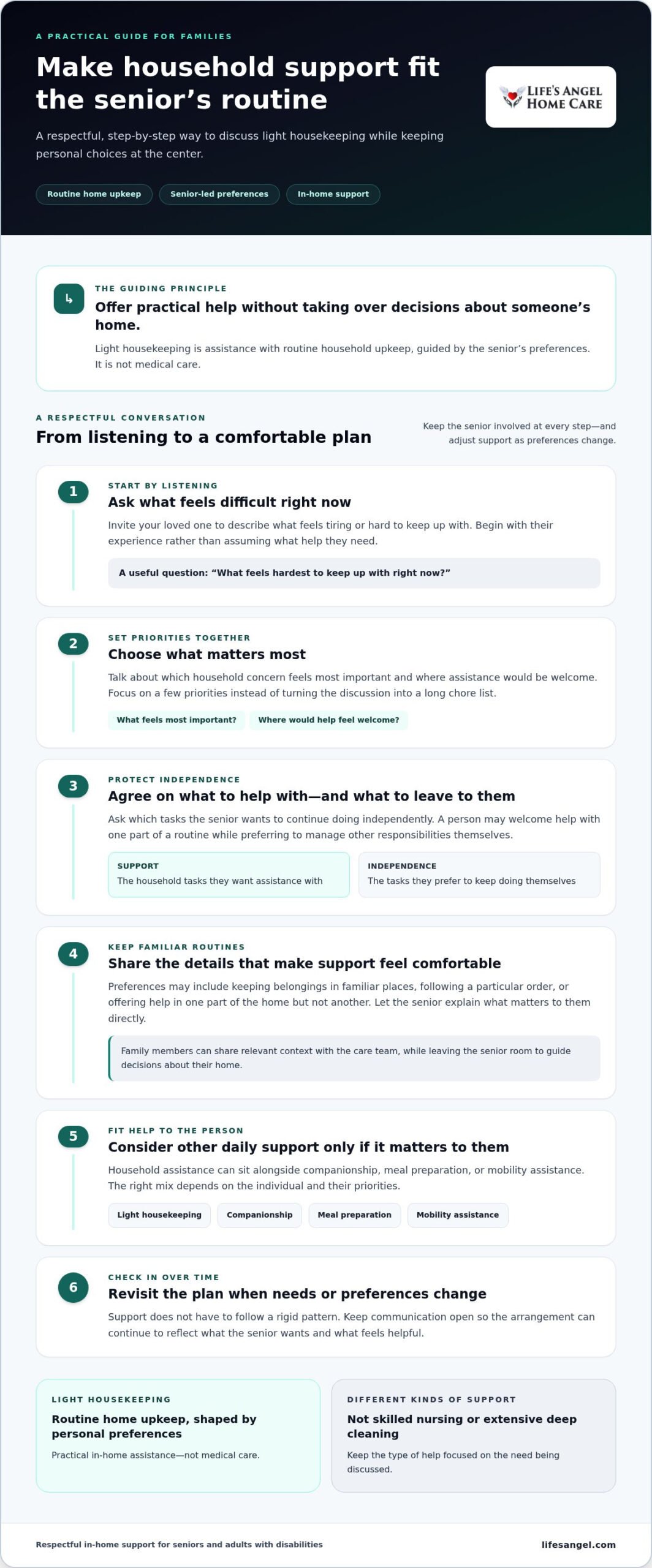
Light housekeeping is assistance with routine household upkeep, guided by a senior’s preferences; it is not medical care. The aim is to make daily life at home more manageable, not to take over the household or change how someone likes things done. Start by asking what the person wants help with and what they prefer to handle themselves.
How household help can support daily life
A home that feels easier to manage can reduce one source of everyday strain for seniors and family caregivers. When relatives are balancing work, home life, and caregiving, practical assistance can help ease the load without placing every household responsibility on one family member.
Light housekeeping can also fit alongside other forms of daily in-home assistance, such as nutrition and meal prep for seniors, companionship, or mobility assistance. The right mix depends on the individual. A senior may welcome help with one part of a routine while continuing to manage other responsibilities independently. Discussing this balance helps keep support focused on what the person actually wants.
What light housekeeping is, and what it is not
Light housekeeping is practical help with ordinary home upkeep, with priorities shaped by the person rather than a preset checklist. It is different from skilled nursing, which involves health-related care, and from a deep-cleaning service focused on extensive cleaning. The elderly care context includes different forms of support, and household help can be one practical part of care at home.
A useful starting question is: “What feels hardest to keep up with right now?” A senior might want help with routine upkeep in a particular part of the home or prefer support that fits an established household routine. These examples can help guide a conversation, but the senior’s own priorities should determine what to discuss. Needs and preferences can also change, so it is useful to revisit them over time.
For families considering light housekeeping for seniors durham nc, describe the everyday challenges without assuming that accepting help means giving up control. Your loved one can explain what matters most, what they want to keep doing, and what assistance would feel comfortable. That conversation gives family members a clearer picture of where practical support may fit.
How Senior-Focused Housekeeping Fits Around Home Routines
A helpful visit starts with listening. Ask your loved one what feels difficult, what they would like help with, and which tasks they prefer to continue doing themselves. That conversation makes household support collaborative instead of leaving the senior feeling that someone else has taken charge.
Preferences can be very specific. A senior may want belongings left in familiar places, prefer a particular order for household routines, or welcome help in one part of the home but not another. Families can share relevant context with the care team and give the senior room to explain their wishes directly. Clear communication helps maintain familiar routines and makes it easier to adjust support when preferences change.
Putting the senior’s preferences first
Before a visit, talk about priorities without turning the conversation into a long chore list. Ask which household concern feels most important and what kind of assistance would be welcome. If a family member knows about a routine that matters to the senior, share that information, then let the senior guide decisions about their home.
Personalized in-home help can fit around familiar routines by following the senior’s preferences instead of expecting them to adapt to someone else’s. The purpose is to offer practical assistance with care and patience, not to replace the person’s choices about their home.
Connecting housekeeping with other daily support
Household assistance can sit alongside companionship or meal preparation, depending on what matters to the person. A senior may appreciate friendly company during a visit as well as practical help with routine home upkeep. These forms of support can complement one another, but the right combination depends on the individual and their priorities.
Personal care is different from household assistance. It concerns support with personal daily living needs, while light housekeeping focuses on routine upkeep in the home. Families considering broader daily living help can explore personal care services in Durham to understand how that support relates to an individual’s needs.
When discussing light housekeeping for seniors durham nc, share a few details that can make the conversation more useful: which routines matter, where help would feel welcome, and what the senior wants to manage independently. Visits do not have to follow a rigid pattern. A conversation with Life’s Angel Home Care about in-home support gives families a chance to explain what would make daily life more comfortable while keeping the senior’s preferences central.
Light Housekeeping or a Cleaning Service: What Fits a Senior’s Needs?
Both household assistance and a cleaning service relate to the home, but they serve different purposes. Consider whether the main need is cleaning-focused work or practical assistance that takes the senior’s routines and preferences into account. This comparison can help your family decide what kind of support to discuss.
| Senior-focused household support | Cleaning service |
|---|---|
| Can be part of broader in-home daily support, with attention to the senior’s needs and preferences. | Generally centers on cleaning tasks requested for the home. |
| Can be discussed in relation to the person’s usual routines and what help feels welcome. | May be a fit when the main need is cleaning rather than support alongside daily living. |
| The senior can help set priorities and decide what they want to continue managing. | The focus is the agreed cleaning work, rather than the senior’s broader daily support needs. |
This is a difference in purpose, not a judgment about which option is better. A family may need cleaning-focused help, household assistance, or a broader mix of daily support. The senior’s wishes and the type of help they want should guide the decision.
When household support may be the more relevant need
Routine upkeep can become harder to fit around other daily activities, even when a senior still enjoys taking part in household routines. A family caregiver may also be balancing work and other responsibilities. In either situation, assistance shaped around the senior’s priorities can complement support from relatives without making assumptions about what the person can or cannot do.
For families considering light housekeeping for seniors durham nc, think about the purpose of the help. Would assistance that fits into a senior’s everyday routine be more useful than a service focused only on cleaning? The answer depends on the household and what the older adult wants. A calm conversation can clarify which kind of support feels appropriate.
Addressing concerns about privacy and independence
Letting someone into a home can feel personal, especially when a senior is used to managing their own space. Discuss privacy, belongings, and boundaries before support begins. Include your loved one, agree on priorities together, and make clear which decisions remain theirs. Accepting help does not mean handing over control.
If friendly company is also a priority, elderly companion care in Durham can be considered alongside household support. Families can talk with Life’s Angel Home Care about in-home support and explain what would make assistance feel respectful and comfortable for their loved one.
How Families Can Make Light Housekeeping Support Work Well
Starting household support can feel easier when the family prepares together instead of trying to solve every concern at once. The senior should have a central voice in deciding what help looks like, even if a relative organizes the conversation. A few clear priorities create a useful starting point without turning support into a rigid chore list.
Agreeing on priorities before a visit
Ask your loved one which household routines or areas they want to discuss. Listen before suggesting solutions, and avoid deciding everything on their behalf. It can help to note preferences, such as what should be left untouched or how the senior likes a familiar routine handled. These details make communication clearer while leaving room for the person to make choices.
To prepare for household support, talk with the senior, identify their priorities, then share relevant routines and preferences.
- Talk together. Explain why you’re discussing help and invite your loved one to share their thoughts.
- Identify priorities. Focus on what feels difficult or important to them, rather than assuming every household task needs attention.
- Share useful context. Describe familiar routines, preferences, and boundaries that can help make support feel comfortable.
Keep the conversation practical and open-ended. Instead of arriving with a predetermined checklist, describe what has been challenging and ask what kind of help would feel welcome. Your loved one may have a different priority than you expect or may want to stay involved in parts of the routine. Respectful communication helps make assistance feel purposeful rather than intrusive.
Bringing household help into a broader care plan
Household support can be discussed alongside other forms of daily assistance, such as companionship, meal preparation, or mobility assistance. Describe how these needs fit together without assuming that every type of help is necessary. If moving around the home is also a concern, senior mobility assistance in Durham can be part of the wider conversation.
For example, your loved one may want to maintain a familiar mealtime routine while receiving help with household upkeep. Or your family may want to discuss how assistance can fit around the senior’s preferred daily rhythm. Sharing this context keeps the conversation focused on the person’s experience, not just the tasks relatives see piling up.
Families in Durham, Chapel Hill, and Raleigh can discuss how light housekeeping fits into a loved one’s in-home support. Contact Life’s Angel Home Care about light housekeeping to talk through your family’s priorities and the routines that matter to the senior.
Light Housekeeping for Seniors in Durham with Life’s Angel Home Care
For families in Durham, household support can be a practical part of caring for a loved one at home. Life’s Angel Home Care provides in-home support for seniors and adults with disabilities, including light housekeeping alongside assistance with everyday needs. Support is guided by the person’s choices, comfort, and familiar routines.
There is no single household routine that suits everyone. A useful conversation starts with what the senior would like help discussing, what they want to continue doing themselves, and what kind of assistance would feel welcome. Rather than assuming a fixed list of tasks, families can explain the challenges they have noticed and the preferences that matter to their loved one. This gives the discussion a personal, practical focus.
A compassionate team for support at home
Life’s Angel Home Care employs board-certified registered nurses, nursing assistants, and care aides. Care staff are BLS and CPR/AED certified. These qualifications provide context about the team, while the senior’s preferences remain central to discussions about everyday assistance.
Light housekeeping can be part of broader in-home support that includes companionship, meal preparation, mobility assistance, personal care, and help with errands. These services address different daily needs, so the appropriate support depends on the person. One family may discuss household help alongside companionship; another may have a different priority. A conversation focused on the senior’s routines can help identify what would make home life more comfortable.
Accepting help can raise questions about privacy, independence, and how things will be handled at home. Give those concerns time and attention. Invite the senior to explain their preferences and listen before making decisions on their behalf. Keeping their voice at the center helps make support feel respectful rather than like a replacement for the choices they can make.
Taking a comfortable next step in Durham
If you’re considering light housekeeping for seniors durham nc, start with what feels difficult to keep up with, what your loved one would welcome, and any routines or boundaries that matter. You do not need a complete plan to begin a useful conversation. Sharing a few priorities can help clarify what kind of in-home assistance may suit your family.
Life’s Angel Home Care is based in Durham and provides in-home support for seniors and adults with disabilities. Families in Durham, Chapel Hill, and Raleigh can discuss the daily routines and household concerns that matter to their loved one. Connect with Life’s Angel Home Care to talk about light housekeeping and other in-home support.
Take a Gentle First Step Toward Support at Home
Welcoming help does not have to mean changing everything at once. A small first step is to listen to your loved one and choose one concern to discuss together. That gives the senior room to say what matters and helps family members move from worry toward a practical conversation.
If you’re considering light housekeeping for seniors durham nc, let your loved one’s comfort guide the pace. Start with questions rather than a complete plan: What would make home life feel easier? What would they like to keep doing themselves? Their answers can help shape a respectful next step.
Life’s Angel Home Care provides in-home support for seniors and adults with disabilities. Start a conversation about support at home and share what your family hopes to make more manageable. You can discuss the senior’s preferences and explore practical support that fits their daily routine.
Frequently Asked Questions
What does light housekeeping for seniors usually include?
Light housekeeping means help with routine household upkeep, with priorities shaped by the senior and the support being discussed. One person may want help maintaining a familiar routine, while another may have different household concerns. It differs from deep cleaning, which focuses on more extensive cleaning. Rather than assume a standard task list, talk with your loved one about what would be useful.
How can light housekeeping help an older adult stay comfortable at home?
Assistance with routine upkeep can make daily life feel more manageable and help a senior maintain familiar ways of using their home. Support can be discussed around the routines that matter to the person, rather than changing how they like their day to unfold. For families considering light housekeeping for seniors durham nc, the senior’s preferences should guide the conversation. Household help supports comfort, but it does not guarantee a particular health or safety outcome.
Is light housekeeping the same as personal care for seniors?
No. Light housekeeping concerns routine support with the home, while personal care relates to an individual’s daily living needs. These services address different concerns, though both can be part of broader in-home support. A family can discuss household upkeep separately from the personal assistance a loved one needs in their daily routine. For more detail, see the guide to personal care services in Durham.
Can a senior receive housekeeping help alongside companionship?
Yes. Household assistance and companionship can complement one another as forms of in-home support. A senior may appreciate help with a household concern as well as friendly conversation during time at home. The right approach depends on the person’s preferences and daily routine, so include them in a conversation about what kind of support feels welcome.
How much does light housekeeping for seniors in Durham, NC cost?
Life’s Angel Home Care bills in-home assistance hourly or on scheduled shifts. The cost depends on the support being arranged, and no price or estimate is provided here. When discussing in-home assistance, describe the needs and routines involved. Contact Life’s Angel Home Care to talk about your family’s needs and service fees.
How can families help a senior feel comfortable accepting housekeeping support?
Start by listening to what your loved one is ready to discuss, then respect their priorities, household routines, and boundaries. A senior may want to decide where personal belongings stay or which parts of a routine they continue to manage. Make room for those choices instead of treating help as an all-or-nothing decision. Accepting support does not mean giving up control; the senior can remain part of decisions about their home.
Does light housekeeping for seniors replace skilled nursing care?
No. Light housekeeping is household assistance, not skilled nursing or medical treatment. Life’s Angel Home Care provides in-home support such as light housekeeping and other daily assistance, which is distinct from clinical care. If you’re unsure what kind of care a health concern requires, speak with an appropriate healthcare professional. A clinician can address medical questions and explain what support may be suitable alongside household assistance.