

What if the clearest sign your parent needs help isn’t one alarming moment, but a pattern of small changes? If you’re looking for “signs aging parent needs home care,” it can be hard to know what matters. A skipped meal or untidy room may happen once; repeated difficulty preparing food, keeping up with personal care, moving safely, or staying connected deserves closer attention.
It’s understandable to worry that offering help could feel intrusive or suggest your parent is losing independence. Noticing a change doesn’t mean you need to rush into a decision. It can be a chance to understand what’s becoming harder and ask what kind of support would feel comfortable.
This article will help you recognize recurring changes in daily routines, consider what they may mean, and start a respectful conversation with your parent. We’ll also explain how non-medical home care can support tasks such as personal care, mobility, meals, errands, and companionship, and where its role ends. The goal is not to take over, but to find thoughtful ways to help your parent feel safe, respected, and at home.
Key Takeaways
- The signs aging parent needs home care are often recurring changes, not one isolated off day; notice whether difficulties affect safety, comfort, or independence.
- Compare changes with your parent’s usual habits, and consider how often they happen and whether daily routines are becoming harder.
- Prepare for a respectful conversation by noting specific observations and asking what feels difficult, rather than leading with criticism or assumptions.
- Use a simple plan to identify your parent’s priorities, preferred routines, and the kinds of support they would welcome.
- Learn what non-medical home care can help with, and when a concern may call for a different kind of support.
Signs an Aging Parent Needs Home Care Often Begin in Everyday Routines
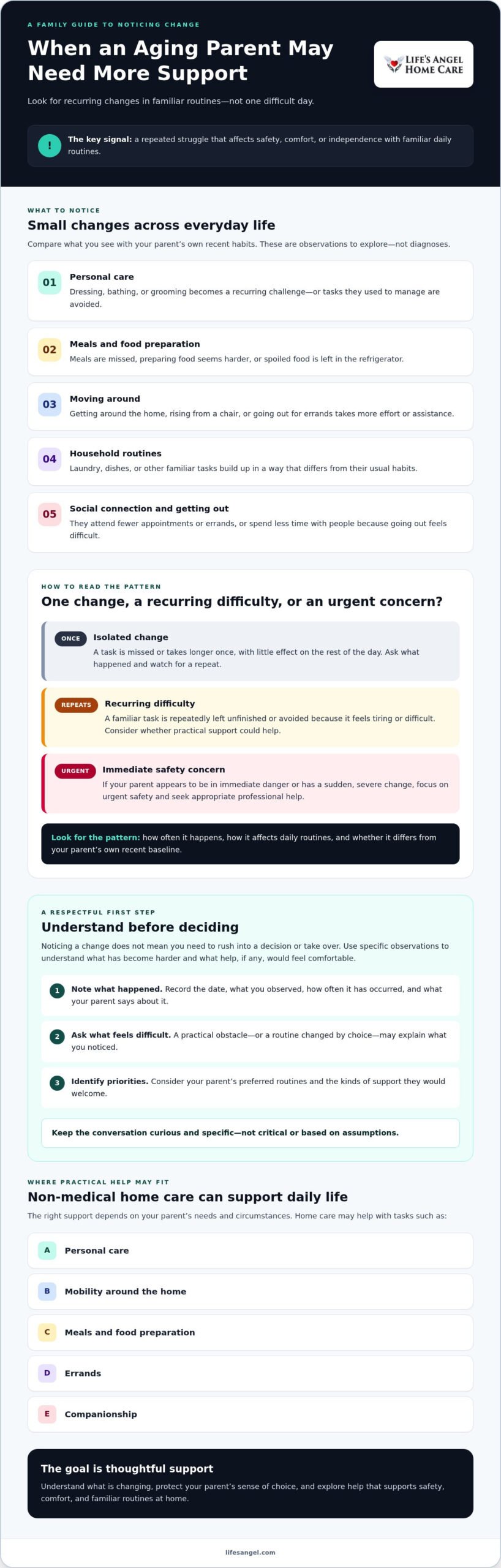
Noticing changes in a parent can stir worry, sadness, and uncertainty, especially when you want to protect their independence. A meaningful sign usually isn’t one difficult day. It’s a repeated struggle that affects safety, comfort, or the ability to manage familiar routines. The signs aging parent needs home care may be subtle at first, appearing in several parts of daily life rather than as one dramatic event.
Pay attention to changes such as:
- Personal care: Dressing, bathing, or grooming becomes a recurring challenge, or your parent starts avoiding tasks they used to manage.
- Meals: Meals are missed, preparing food seems harder, or spoiled food remains in the refrigerator. These are observations, not diagnoses.
- Mobility: Moving around the home, getting in and out of a chair, or going out for errands takes more effort or assistance.
- Household routines: Laundry, dishes, or other familiar tasks build up in a way that’s different from your parent’s usual habits.
- Social connection: Your parent attends fewer appointments or errands, or spends less time with people because getting out feels difficult.
These examples can help families think about what kind of senior daily living assistance may be appropriate. For a broad overview of elderly care and its different forms, see the linked reference; the right kind of help depends on a person’s needs and circumstances.
Which changes in daily activities should families notice?
Look for specific changes rather than interpreting them as proof that your parent can no longer manage alone. Perhaps they’re wearing the same clothes more often, struggling to prepare a familiar meal, or postponing an appointment because the trip feels tiring. Ask what’s behind the change. Your parent may describe a practical obstacle you hadn’t considered, or explain that a routine has changed by choice.
When does a small change become a pattern?
Note what happened, how often it occurs, and how it affects your parent’s usual routine. Compare today with their own recent baseline, not with another person of the same age. A single missed meal or untidy room may have a simple explanation; repeated difficulties across routines deserve a thoughtful conversation. Listen to your parent’s account, and treat your notes as a way to understand, not as a verdict.
Keeping observations calm and specific can make the next discussion easier. You don’t have to decide on ongoing care based on one concern. Start by understanding what’s changed and what kind of help, if any, your parent would welcome.
How to Tell Normal Variation from Signs an Aging Parent Needs Home Care
It can be hard to know whether a change is a passing variation or a sign that your parent could use more help. Rather than labeling a behavior as normal aging or guessing at its cause, consider how often it happens, how it affects daily routines, and whether it differs from your parent’s own recent baseline. The phrase “signs aging parent needs home care” points to a concern worth exploring, not a diagnosis or a decision you need to make immediately.
Isolated change: A task is missed or takes longer once, with little effect on the rest of the day. Ask what happened and keep an eye out for a repeat.
Recurring difficulty: A familiar task is repeatedly left unfinished or avoided because it feels tiring or difficult. Consider whether practical support could make the routine easier.
Immediate safety concern: Your parent appears to be in immediate danger or has a sudden, severe change. Focus on urgent safety and seek appropriate professional help.
Several small difficulties can add up. For example, if getting around the kitchen takes more effort, your parent might put off preparing meals; that can then affect the regular rhythm of the day. A family log can help you see what’s happening without jumping to conclusions. Write down the date, what you observed, how often it has occurred, and what your parent says about it. This gives everyone a clearer starting point for a conversation. The National Institute on Aging’s Planning for home care guidance also offers ideas for assessing needs and beginning caregiving conversations.
What patterns may show that daily support could help?
Notice repeated tasks your parent avoids or cannot finish as easily as before, such as preparing a meal, completing household routines, or getting out for an errand. Look at the combined effect: a few unfinished tasks may mean the day’s routine is becoming harder to manage. Ask your parent what feels challenging and what kind of help, if any, would feel welcome. Your observations are a starting point, not proof of what they need.
Which sudden changes call for prompt professional attention?
Planning ongoing support is different from responding to sudden confusion, a new severe symptom, or immediate danger. Contact a healthcare professional about concerning changes rather than assuming home care will address their cause. If the situation appears to be an emergency, contact local emergency services. Non-medical in-home support may help with everyday routines, but it isn’t a substitute for urgent or medical care.
Once you’ve identified recurring daily tasks where practical assistance may help, you can explore options at a pace that feels right. For example, non-medical in-home care support may include help with personal care, mobility, meals, errands, or appointments.
What to Do When Your Aging Parent Needs Help
Once you’ve noticed a change, the next step doesn’t have to be a major decision. Approach the conversation as a way to understand what your parent wants and what might make daily life easier. A calm, collaborative process can protect their sense of control while helping your family consider whether the signs aging parent needs home care point to practical support worth exploring.
Start with a few manageable steps:
- Observe: Notice which tasks seem harder, without turning each moment into a test.
- Write down examples: Record what happened and how it affected the routine, so you can speak clearly rather than relying on general worries.
- Ask what feels difficult: Invite your parent to explain their experience and listen before suggesting a solution.
- Explore options together: Discuss what help they might welcome, and let them guide the priorities wherever possible.
Choose a private, unhurried moment when neither of you needs to rush. Use specific, gentle observations instead of criticism: “I noticed the trip to the store seemed tiring last week. How did it feel for you?” That leaves room for your parent’s perspective and makes the conversation less like a judgment about their abilities.
How can you talk with a parent who resists help?
Begin with care and curiosity. Ask which parts of the day feel harder, then listen without arguing them into accepting help. Support can feel deeply personal, so acknowledge that it may take time to consider. If your parent is open to it, suggest trying one small, clearly bounded form of assistance as a starting point, not an ultimatum. Revisit the conversation later if they’re not ready.
What observations should families bring to a care discussion?
Bring concrete examples, how often they occur, and what kind of help your parent says they would welcome. Ask what independence means to them and which routines they most want to preserve. If you’ve noticed health-related changes, encourage your parent to discuss them with a healthcare professional; home support doesn’t replace medical assessment. For mobility-related planning, this senior mobility buying guide can help families consider relevant needs and questions.
Keep the focus on your parent’s goals. They may want support with one task while continuing to manage others themselves. Agreeing on a practical next step together can make the idea of help feel more respectful and less overwhelming.
How Home Care Can Support an Aging Parent’s Daily Life
Home care can add practical, non-medical support to the care family members already provide. Rather than taking over, a caregiver can help with selected routines in ways that respect your parent’s preferences and preserve the parts of the day they still manage comfortably. If you’re considering the signs aging parent needs home care, it helps to identify specific tasks where an extra pair of hands could make daily life feel easier.
Which everyday tasks can an in-home caregiver help with?
Support can be shaped around a person’s needs and choices. Depending on the services arranged, it may include:
- Personal care: Assistance with everyday personal-care routines, offered respectfully and with attention to the parent’s preferences.
- Mobility assistance: Help with moving through daily routines while supporting the parent’s comfort and independence.
- Meals and home routines: Meal preparation and light housekeeping to help keep familiar routines manageable.
- Connection and errands: Companionship and assistance with errands, which can make it easier to stay engaged with everyday activities.
- Appointments: Accompaniment to planned appointments for personal support. This is not emergency transportation or ambulance service.
For more detail on support with everyday personal routines, see this personal care services guide. Families can use it to consider which tasks matter most to their parent and what questions to ask when exploring options.
When might another kind of support be needed?
Non-medical home care can assist with daily activities, but it isn’t a substitute for medical evaluation or emergency response. Discuss health concerns with an appropriate healthcare professional, and contact local emergency services if there’s an apparent emergency. Life’s Angel Home Care does not provide 24/7 live-in skilled nursing, so families who need that level of care should seek an appropriate provider.
Before deciding, clarify the tasks your parent wants help with, the schedule they need, and whether support is currently available where they live. Life’s Angel Home Care serves Durham, Chapel Hill, and Raleigh; confirm current availability and discuss whether its non-medical services fit your family’s needs. If you’re considering support with personal care, mobility, meals, errands, companionship, or appointments, explore Life’s Angel Home Care options as one step in planning.
Planning Home Care for an Aging Parent in Durham and the Triangle
Once your family has a clearer picture of what feels difficult, a simple plan can make the next conversation less overwhelming. The signs aging parent needs home care may point to just one or two routines where practical support could help. Start with your parent’s priorities, and build the discussion around what they want to keep doing for themselves.
Before contacting a provider, talk together about:
- Priorities: Which parts of daily life matter most to your parent, and what would they like to keep managing independently?
- Preferred routines: Note the usual timing and approach for important daily activities.
- Support tasks: Identify the specific help being considered, such as personal care, mobility assistance, meal preparation, errands, or accompanied appointments.
- Family communication: Agree on who will share updates and how your parent wants family members involved.
If getting up, sitting down, or moving between surfaces is a concern, review this safe home mobility transfer guide as a starting point for questions. A guide cannot assess an individual situation, so discuss any hands-on mobility concerns with an appropriate professional.
How can families begin exploring local support?
Prepare a brief description of your parent’s needs and preferred routines, then ask providers about caregiver qualifications, duties, scheduling, and how support is coordinated. Be specific about the tasks your parent wants help with, and confirm what a provider can and cannot do. Life’s Angel Home Care serves Durham, Chapel Hill, and Raleigh; confirm current availability in your parent’s location and ask about arrangements directly. Don’t assume a particular schedule or service is available until it’s confirmed.
What can a first conversation with a home-care agency cover?
A first discussion can help you explain your parent’s priorities, describe daily challenges, and ask questions without committing to a decision. Clarify which needs fit non-medical home care and which may require another provider, such as medical assessment or emergency response. It’s also reasonable to ask how the proposed support would respect your parent’s choices and familiar routines.
Taking time to ask questions is part of making a thoughtful plan, not a promise that your family must move forward. If you’d like to discuss whether non-medical support with daily routines may fit, talk with Life’s Angel Home Care and share what your parent needs and prefers.
Take the Next Step at Your Family’s Pace
The signs aging parent needs home care are often recurring difficulties that make familiar routines harder, not one isolated change. Notice what’s different from your parent’s usual habits, keep specific examples, and invite them to share what feels challenging. A thoughtful conversation can help your family explore support without treating care as a loss of independence.
Non-medical in-home care may help with selected daily tasks, including personal care, mobility assistance, companionship, meal preparation, errands, and accompanied appointments. Life’s Angel Home Care reports employing board-certified registered nurses, nursing assistants, and care aides; its nursing assistants and care aides are reported to hold BLS and CPR/AED certifications. Ask about the support your parent needs and confirm current service availability and arrangements.
You don’t need to have every answer before asking questions. Talk with Life’s Angel Home Care about supportive next steps and explore whether its non-medical services may fit your family’s needs. A calm, gradual plan can help your parent feel heard while giving you a clearer path forward.
Frequently Asked Questions
What are the first signs an aging parent may need help at home?
Early signs are often repeated changes in familiar routines, such as difficulty preparing meals, managing personal care, getting around, or keeping up with errands. Compare what you notice with your parent’s own usual abilities rather than another person’s. Share specific examples and ask how your parent feels about them. If a change raises health concerns, encourage your parent to discuss it with an appropriate healthcare professional.
How do I know if my parent needs home care or just occasional help?
Consider how often a task becomes difficult and whether it affects comfort, safety, or routines your parent values. Occasional help may address a one-time need, while recurring difficulties may be a reason to explore broader support. Ask your parent which tasks they would welcome help with. If the change may be health-related, a healthcare professional can assess it; home care planning alone can’t determine the cause.
Is it normal for an aging parent to need more help with daily activities?
There’s no single change that defines what’s normal for every older adult. A gradual change may still deserve attention if it repeatedly affects daily life, comfort, or independence. Avoid assuming age is the cause. Note what you’ve observed, ask your parent about their experience, and discuss health concerns with a professional. A pattern of difficulty can help your family decide whether practical support is worth exploring.
Can home care help my parent stay independent?
Non-medical home care may support independence by helping with agreed tasks while your parent remains involved in daily choices and routines. Depending on needs and confirmed availability, support may include personal care, mobility assistance, meal preparation, companionship, errands, or accompanied appointments. Ask providers to clarify their service scope and scheduling. In Durham, Chapel Hill, and Raleigh, confirm directly whether a provider’s services are currently available in your parent’s area.
What should I do if my parent refuses home care?
Start by asking what concerns your parent and listening without expecting to settle the question in one conversation. Share a specific change you’ve noticed, then ask what kind of support, if any, might feel acceptable. A small, clearly limited form of help may feel easier to consider than a major change. Give your parent time to think. For health concerns, encourage them to speak with a healthcare professional.
When should I be concerned about sudden changes in an older adult?
Sudden confusion, a new severe symptom, or an immediate safety concern calls for prompt attention, not just ongoing home-care planning. Contact an appropriate healthcare professional about concerning changes, and use local emergency services if the situation appears to be an emergency. Don’t try to diagnose the cause yourself. For changes that aren’t urgent but continue over time, record examples and discuss them with your parent and their care team.
What kind of help can a non-medical home-care aide provide?
Depending on the provider’s services and your parent’s needs, non-medical support may include personal care, mobility assistance, companionship, meal preparation, light housekeeping, errands, and accompaniment to appointments. Life’s Angel Home Care offers these types of support in Durham, Chapel Hill, and Raleigh, but families should confirm current local availability and scheduling. Ask which tasks are included and what qualifications caregivers have. Non-medical care doesn’t replace medical evaluation or emergency services.